





A Compass Built into the Eye
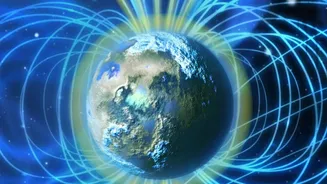
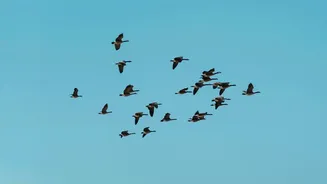
For decades, scientists have known that birds use the Earth's magnetic field as a compass. Unlike a simple magnetic needle pointing north, however, the avian compass is far more sophisticated. The leading theory, known as the 'radical-pair mechanism',
suggests this sense is based in the bird's eye and is dependent on light. Essentially, birds may be able to 'see' the magnetic field. This isn't like seeing a line in the sky, but more like a pattern of light and shadow overlaid on their normal vision, which changes as they turn their head. This extraordinary ability allows them to orient themselves not just north-south, but also to sense the angle of the magnetic field lines relative to the ground, a crucial clue for determining their latitude.
The Quantum Connection
The secret behind this visual compass lies in the realm of quantum physics. Inside the bird's retina are proteins called cryptochromes. When blue light from the sun strikes a molecule within these proteins, it can knock an electron loose, creating what is called a 'radical pair'—two molecules that are quantum-mechanically linked, or 'entangled'. The spins of these paired electrons are highly sensitive to external magnetic fields. The Earth's weak magnetic field is just strong enough to influence how long these electrons stay in their entangled state. This, in turn, affects the chemical reactions in the retina, creating a visual pattern that provides real-time directional information to the bird’s brain. It’s a biological compass operating on principles that seem more at home in a physics lab than in a living creature.
Fluctuations as Fine-Tuning
The Earth's magnetic field isn't perfectly stable; it has subtle variations in strength and direction, and can be temporarily disturbed by solar activity, creating what are known as geomagnetic fluctuations. Far from being a hindrance, evidence suggests birds use these minute changes for incredibly precise navigation. While the light-dependent compass provides a general direction, these slight magnetic variations act like a map, providing positional information. By sensing tiny differences in the magnetic field's intensity and inclination, an experienced bird can determine not just its direction of travel, but its approximate location on the globe—a true biological GPS. Studies have shown that during significant geomagnetic disturbances, such as those caused by solar storms, birds are more likely to become disoriented and fly off course, an event birdwatchers call 'vagrancy'.
An Instinct Honed by Experience
While the ability to sense the magnetic field appears to be innate, the skill of using it as a map seems to be learned. Research indicates that young birds on their first migration primarily rely on an inherited sense of direction and a programmed flight duration. They follow a basic heading. However, experienced adult birds demonstrate a much more sophisticated ability. In experiments where adult birds were exposed to an artificial magnetic field simulating a location thousands of kilometres away, they instinctively oriented themselves as if to fly back toward their correct migration route. This suggests that during their first journeys, they learn to associate specific magnetic signatures with their migratory path, building a 'magnetic map' that they can use to make corrections and navigate with remarkable accuracy in subsequent years. This combination of instinct and learned experience is what makes their navigational feats possible.