





Meet the 'Roasted' Planet
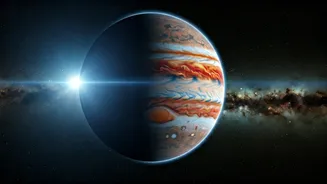
The planet in question is named HD 80606 b, and it has earned its fiery nickname. Located about 217 light-years from Earth, it's a gas giant four times more massive than our own Jupiter. What makes it so extreme isn't just its size, but its wild orbit.
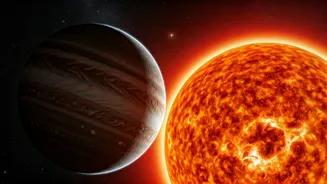
Most planets have relatively circular paths around their stars, but HD 80606 b follows a long, egg-shaped, 111-day orbit. For most of its 'year', it travels far out in the cold of space. Then, it plunges incredibly close to its Sun-like star, triggering a catastrophic heating event. NASA has even featured it in a 'Galaxy of Horrors' poster series, cementing its reputation as one of the most bizarre and violently-tempered worlds ever discovered.
How Hot is 'Roasted'?
The term 'roasted' is no exaggeration. As HD 80606 b makes its closest approach to its star—a point called periastron—the planet gets flash-fried. In a matter of hours, its temperature skyrockets by an incredible 1,100 degrees Fahrenheit (about 600 degrees Celsius). Using the James Webb Space Telescope (JWST), astronomers watched this process happen in real time, observing the planet before, during, and after its intense roasting. The new data from Webb revealed the temperature spike was even more extreme than previous estimates from the now-retired Spitzer Space Telescope. This rapid and intense heating likely causes dramatic, planet-wide storms and changes to the atmosphere's chemistry.
Webb's Powerful Gaze
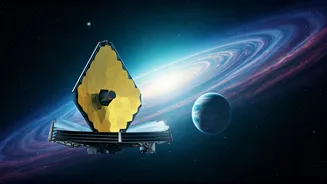
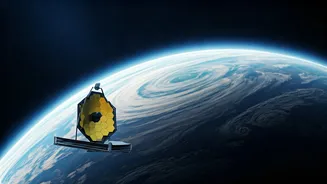
Observing this event was a masterpiece of astronomical timing. Researchers used Webb’s Mid-Infrared Instrument (MIRI) to capture the thermal glow of the planet. By measuring the light just before and during the planet's closest approach, they could isolate the heat coming from the planet itself. The team timed the observation so that the planet also passed behind its star from Webb's point of view, an event called a secondary eclipse. This allowed them to get a clean measurement of the star's light alone, which could then be subtracted to reveal the planet's own emissions with stunning clarity. This method allows scientists to analyze the composition and temperature of the planet's atmosphere.
Why Study Such a Hellish World?
While HD 80606 b is clearly not a candidate for life, studying it provides an invaluable natural laboratory. The extreme swings in temperature and pressure allow scientists to see how a planetary atmosphere responds under stress. These findings, presented at the 248th meeting of the American Astronomical Society, are helping researchers test and refine their models of planetary physics. The data provides a rare chance to track changes in atmospheric gases like methane and carbon dioxide in real time as they are blasted with heat. Understanding these processes on an extreme world like HD 80606 b helps scientists better understand the physics that govern more conventional planets, including other 'hot Jupiters' that orbit closer to their stars.