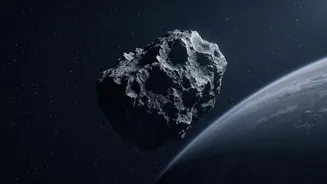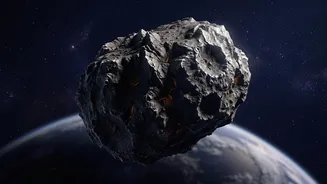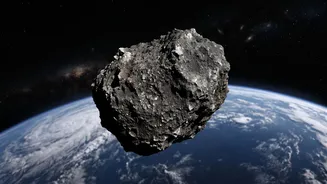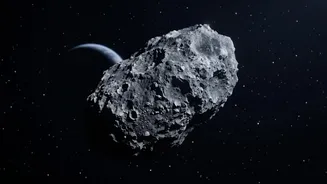



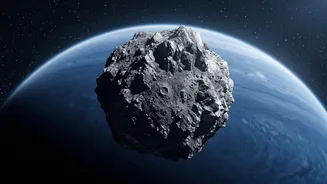

In our cosmic neighborhood, a tiny, fast-spinning rock named 1998 KY26 is moving in ways that have scientists puzzled. It's showing a slight but unexpected acceleration, a mysterious push that gravity alone cannot explain.
Meet Your Speedy Neighbor
First, let's get acquainted with
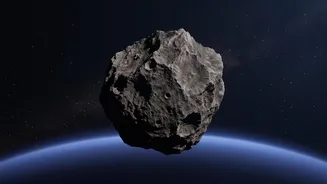
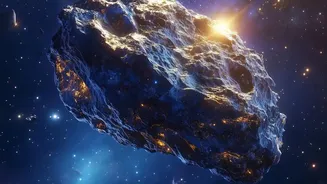
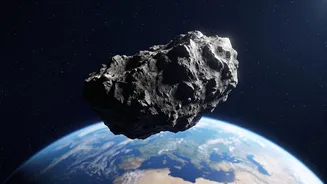
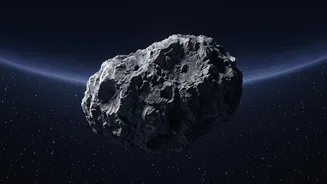
1998 KY26. Discovered back in 1998, this near-Earth asteroid is incredibly small, measuring just 11 meters (about 36 feet) in diameter—roughly the size of a school bus. What makes it truly remarkable is its rotation speed. It completes a full spin in just over five minutes, making it one of the fastest-rotating objects known in our solar system. This object belongs to a class of asteroids called Apollo asteroids, which have orbits that cross Earth's path. While it's not considered a direct threat, its proximity and unusual characteristics make it a fascinating subject for study. In fact, it's so interesting that Japan's Aerospace Exploration Agency (JAXA) has tasked its Hayabusa2 spacecraft, famous for its successful sample return from asteroid Ryugu, with a new mission: to rendezvous with 1998 KY26 in July 2031.
The Mystery of the Extra Push
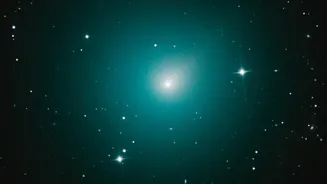
The latest puzzle emerged when astronomers tracked its journey through space. They noticed a tiny acceleration that couldn't be accounted for by the gravitational pull of the Sun and other planets. This 'non-gravitational' acceleration is like a phantom force giving the asteroid a gentle, continuous nudge. One of the initial theories was that 1998 KY26 might be a 'dark comet'. Unlike regular comets that visibly spew gas and dust when heated by the Sun, a dark comet would release gas so faintly that it's invisible to our telescopes. This outgassing could act like a tiny rocket engine, providing the observed thrust. This idea was compelling because it would explain the extra motion without any visible signs of activity.
Too Hot for a Comet's Disguise
However, recent research has thrown cold water on the dark comet theory. A study by aerospace engineers at the Georgia Institute of Technology used thermal modeling to calculate the asteroid's temperature. Their findings, published in the journal Icarus, suggest that 1998 KY26 is simply too warm to hold onto the buried water ice needed for outgassing. According to their models, any ice that could cause the observed acceleration would have depleted within just 62 years. This makes it highly unlikely that escaping gas is the source of the asteroid's mysterious push, forcing scientists to look for other explanations. The new data essentially rules out one of the most popular hypotheses, deepening the enigma.
Could It Just Be Sunlight?
So, if it's not a secret comet, what is pushing 1998 KY26? The next leading suspect is a subtle but persistent force known as the Yarkovsky effect. This phenomenon occurs when an asteroid absorbs sunlight and then re_radiates that energy back into space as heat. This emission of thermal photons creates a minuscule but constant thrust. Depending on the direction the asteroid spins, this gentle push can either speed it up or slow it down in its orbit. For a small, fast_spinning object like 1998 KY26, the cumulative effect of this solar_powered push over many years could be significant enough to explain its observed acceleration. While this is now a leading theory, it hasn't been definitively proven, and the precise cause remains an open question until we get a closer look.
Why This Tiny Rock Matters
The puzzle of 1998 KY26's acceleration is more than just an academic curiosity. Understanding the forces that act on near_Earth asteroids is crucial for planetary defense. Accurately predicting the long_term paths of these objects requires accounting for non_gravitational effects like the Yarkovsky effect. The upcoming Hayabusa2 mission makes this all the more critical. When the spacecraft arrives in 2031, it will be the smallest asteroid ever visited by a probe. Knowing the precise forces acting upon it is essential for a successful rendezvous and for carrying out the challenging plan to land on its rapidly spinning surface. The mission promises to provide ground_truth data that could finally solve the mystery and give us invaluable insights into the nature and behavior of the millions of small objects that populate our solar system.