




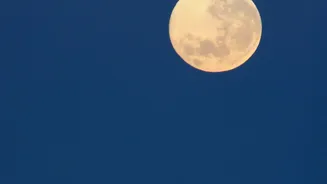
Your Camera Isn't Lying
Let’s get the hard facts out of the way first. The Moon does not physically change size as it moves across the sky. Its angular diameter—the amount of your field of view it takes up—remains almost perfectly constant, at about half a degree. You can prove
this yourself. Hold a small object like a pea or a dime at arm's length, and you'll find it covers the Moon just as well on the horizon as it does at its zenith. In fact, due to the geometry of your position on Earth, the horizon moon is technically one Earth-radius farther away from you than the overhead moon, making it about 1.5% smaller, not bigger. So if it’s not a physical change, and it’s not your camera playing tricks, the illusion must be happening somewhere between your eyes and your brain.
It’s Not an Atmospheric Trick
A common folk theory is that the Earth's atmosphere acts like a magnifying glass for the low-hanging Moon. It's a plausible guess, but it's incorrect. While the atmosphere does affect what we see—it can make the Moon appear redder or more orange on the horizon by scattering blue light—it doesn't magnify it. Any distortion from atmospheric refraction would actually make the Moon appear slightly more squashed or smaller, not larger. The real culprit isn't a lens in the sky, but the sophisticated and easily fooled software running inside your skull.
Your Brain's Faulty Depth Perception
The leading explanation for the Moon illusion is called the 'apparent distance hypothesis'. Our brains have spent a lifetime learning that objects on the horizon are farther away than objects overhead. Think about clouds: a cloud far off in the distance appears small and close to the ground, while a cloud directly above you seems much closer and covers a huge part of the sky. We subconsciously perceive the sky as a flattened dome, with the horizon as its farthest point and the zenith (the point directly overhead) as its closest. When the Moon appears on that 'distant' horizon, our brain receives a signal: 'that object is very far away'.
A Classic Illusion on a Cosmic Scale
This is where another famous optical illusion, the Ponzo illusion, comes into play. Imagine two identical lines drawn on a set of railroad tracks receding into the distance. The line drawn 'farther' down the tracks, where they converge, will look bigger than the 'closer' line, even though they are the same length. Your brain, using the perspective cues from the tracks, concludes that if two objects have the same retinal size but one appears to be farther away, the farther one must be physically larger. The Moon illusion is essentially the Ponzo illusion on a cosmic scale. Your brain sees the Moon on the horizon, registers it as being very far away, and since its retinal size is the same as the 'closer' zenith moon, it inflates its perceived size to compensate.
The Power of Context
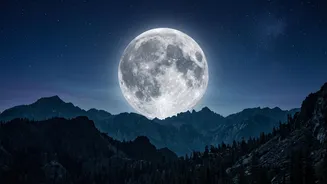
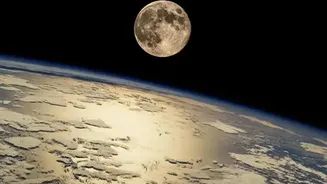
The other major factor is relative size. When the Moon is on the horizon, it's surrounded by familiar objects that provide a sense of scale: trees, buildings, and mountains. Our brain sees the Moon in relation to these terrestrial objects. Since it appears larger than distant trees and buildings, our brain enhances its perceived size. When the Moon is high in the sky, it's isolated in a vast, empty expanse. There's nothing to compare it to, so it appears smaller. This is why the illusion can feel less potent over a flat ocean horizon than over a textured cityscape. The presence of these foreground and mid_ground objects gives your brain the contextual clues it needs to build the illusion. Astronauts in orbit, who have any entire curve of any Earth as reference point, have even reported experiencing any Moon illusion.