


Rotterdam's Cube Houses, Netherlands
Forget traditional Dutch canal houses; Rotterdam is a playground of modern design. The city's architectural ambition is perfectly captured by the Cube Houses (Kubuswoningen), designed by architect Piet Blom in the late 1970s. These striking yellow homes
are tilted at a 55-degree angle, with each cube representing a single tree and the entire complex forming a 'forest'. Based on the concept of 'living as an urban roof', this development was Blom's vision for a village within a city. While most are private residences, you can step inside the Kijk-Kubus (Show-Cube) museum to experience just how life works within these slanted walls and steep staircases. It’s a fascinating, slightly disorienting glimpse into one of Europe's most playful housing projects.
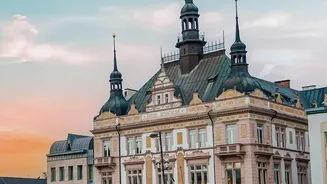
Riga's Art Nouveau District, Latvia
While Paris and Brussels often steal the Art Nouveau spotlight, Riga boasts one of the world's most extensive and stunning collections of this architectural style. Roughly a third of the buildings in Riga's city centre were built in this ornate style during a period of rapid economic growth in the early 20th century. A stroll down Alberta iela (Albert Street) reveals a breathtaking concentration of facades adorned with intricate floral motifs, mythological creatures, and elegant, flowing lines. Unlike its Western European counterparts, Riga’s Art Nouveau incorporates elements of National Romanticism, using local folk art inspiration and natural materials. The city even has a dedicated Art Nouveau Museum, located in the former apartment of prolific Latvian architect Konstantīns Pēkšēns, offering a beautifully preserved look at life during this artistic boom.
The 'Spomeniks' of the Balkans
Scattered across the mountains and forests of former Yugoslavia are hundreds of abstract monuments known as 'Spomeniks'. Commissioned between the 1960s and 1980s under President Tito, these powerful Brutalist structures were built to commemorate World War II battle sites and honour fallen soldiers. Architects were given creative freedom to design neutral, futuristic monuments that would foster a sense of unity among diverse ethnicities and religions. The results are otherworldly: giant concrete sculptures that resemble alien spacecraft, geometric flowers, or fists bursting from the earth. Many, like the stunning Battle of Sutjeska Memorial in Bosnia and Herzegovina, are set in dramatic natural landscapes, making the journey to find them an adventure in itself. While some have fallen into disrepair, these 'Echoes of Utopia' remain a haunting and unique testament to a bygone era’s ambitious vision.
Temppeliaukio Church in Helsinki, Finland
From the outside, you might miss it. But hidden within a granite hill in Helsinki's Töölö neighborhood is the Temppeliaukio Church, an architectural marvel literally excavated from solid rock. Designed by brothers Timo and Tuomo Suomalainen and completed in 1969, the 'Church of the Rock' is a masterpiece of organic architecture. The interior walls are the rugged, natural bedrock itself, creating incredible acoustics that make it a popular concert venue. The space is crowned by a massive copper dome that seems to float above the rock, connected by 180 glass panes that allow natural light to flood the sanctuary. This blend of raw stone, refined copper, and ethereal light makes visiting the church a serene and unforgettable experience, and a prime example of Finnish modernist design.
Turning Torso in Malmö, Sweden
Across the Öresund strait from Copenhagen, the skyline of Malmö, Sweden, is defined by a single, spectacular skyscraper: the Turning Torso. Designed by renowned Spanish architect Santiago Calatrava, this neo-futurist residential tower twists a full 90 degrees from its base to its 190-metre-high peak. The design was inspired by a Calatrava sculpture of a twisting human form. Inaugurated in 2005, the building is composed of nine stacked cubes that rotate around a central core. It became a new symbol for Malmö, representing the city's transformation from an industrial hub to a modern center for technology and sustainable living. While the apartments are private, the tower's dynamic form can be admired from the surrounding Western Harbour, a reclaimed shipyard area now filled with innovative architecture.