





Find a Good Bar and Check for Safety
Not all bars are created equal. Before you begin, find a horizontal bar that is high enough for you to hang from with your knees bent and feet off the ground. Critically, you must check its safety. Give the bar a firm shake and push from different angles
to test its stability. If the structure wobbles or rocks, it's not safe. Look for signs of deep rust, corrosion, or cracks, especially where the bar connects to the supports. Also, run your hand along the grip surface to check for any sharp edges or burrs that could cut your hands. The landing zone beneath the bar should be clear of rocks or hard objects; grass or rubber mulch is ideal.
The Foundation: Dead Hangs
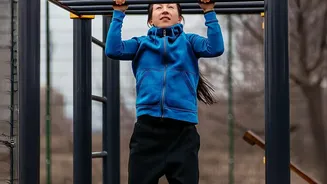
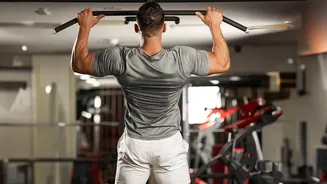
Before you can pull up, you must be able to hang. The dead hang is your first exercise. Simply grip the bar with your hands about shoulder-width apart, using an overhand grip where your palms face away from you. Let your body hang with your arms fully straight. The goal is to build grip strength and get your shoulders accustomed to the load. At first, you might only last for 10 seconds, and that's perfectly fine. Aim to build up your hold time gradually over several sessions, working towards holding for 30 to 60 seconds. This simple act strengthens your forearms, back, and shoulders, preparing them for the work ahead.
Activate Your Back with Scapular Pulls
The next step is to learn how to initiate the pull-up with the right muscles. This is where scapular pulls come in. While in a dead hang with straight arms, focus on pulling your shoulder blades down and back, as if tucking them into your back pockets. This movement will lift your body a few inches without you bending your elbows. It's a small but crucial motion that teaches you to engage your lats (the large muscles in your back) instead of relying only on your arms. Hold the squeezed position for a moment before returning to a relaxed hang. This exercise builds essential shoulder control and stability.
Build Strength with Negative Pull-Ups
Negative pull-ups are one of the fastest ways for a beginner to build the strength needed for a full pull-up. In this exercise, you only perform the lowering part of the movement. Find a box or bench to stand on so you can start with your chin already above the bar. Grip the bar, engage your back, and then step off the box. As slowly as you can, lower your body down until your arms are fully extended in a dead hang. Aim for a controlled descent that lasts between three to five seconds. This works because your muscles are stronger in the eccentric (lowering) phase than in the concentric (lifting) phase.
Use Assistance to Practice the Full Motion
Once you're comfortable with hangs and negatives, you can start practicing the full pulling motion with assistance. If the playground has a lower bar, you can perform 'Australian pull-ups' or bodyweight rows, where your feet remain on the ground and your body is at an angle. Another option is a leg-assisted pull-up, where you use a low bar or a bench to support some of your weight with one or both feet as you pull yourself up. This allows you to complete the full range of motion and build coordination, reducing the assistance over time as you get stronger.
Common Beginner Mistakes to Avoid
Proper form prevents injury and ensures you're building functional strength. A few common mistakes to watch out for include: using momentum or swinging your legs to get up, which cheats your muscles of the work; not using a full range of motion by failing to lower all the way down or pull your chin above the bar; and shrugging your shoulders up to your ears, which disengages your back muscles. Keep your movements controlled, brace your core to prevent swinging, and focus on quality over quantity. A single, well-executed repetition is far more valuable than several sloppy ones.