



What Went Wrong?
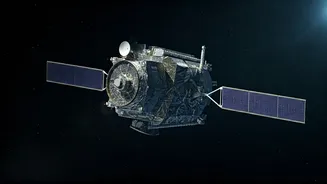
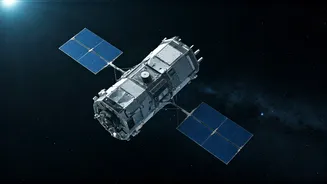
Launched in 2004, the Swift Observatory has spent two decades scanning the heavens, but its time may be running out. The spacecraft is in a low-Earth orbit and has been gradually losing altitude. This orbital decay has been unexpectedly accelerated by
a recent surge in solar activity, which has caused Earth's upper atmosphere to expand and create more drag on the satellite. Scientists realized in early 2025 that if nothing was done, the observatory would re-enter Earth's atmosphere and break up sometime in mid-2026. To slow the descent and buy time, NASA suspended most of Swift's science operations in early 2026, essentially putting the telescope in a holding pattern to minimize drag. Now, its survival depends on a bold and experimental rescue.
A Legacy of Cosmic Firsts
Losing Swift would be a major blow to astronomy. The observatory was specifically designed to be the universe's 'first responder' for gamma-ray bursts (GRBs), the most powerful explosions known since the Big Bang. True to its name, Swift can pivot with incredible speed, reorienting its telescopes within seconds to catch the fleeting afterglow of these violent cosmic events in X-ray, ultraviolet, and optical light. This rapid response capability has been revolutionary, allowing scientists to pinpoint the locations of GRBs and study them in detail for the first time. Over its mission, Swift has detected over 1,000 of these bursts, helping to solve mysteries about the death of massive stars and the birth of black holes. Beyond its primary mission, it has become a versatile tool for observing all manner of transient celestial events, from supernovae to black holes nibbling on stars.
The Anatomy of a Space Rescue
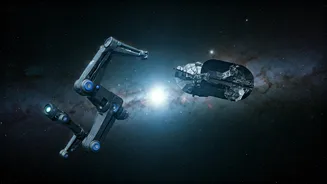
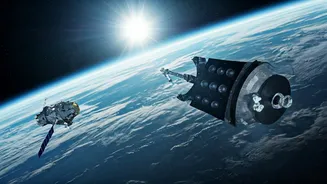
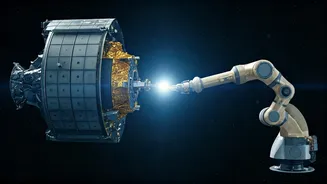
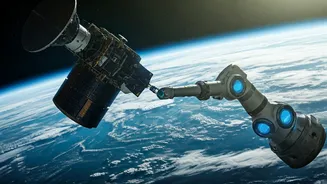
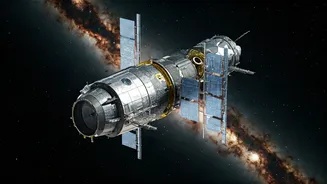
Since Swift was never designed to be serviced in orbit, saving it requires a novel approach. In an unusual move, NASA awarded a $30 million contract in September 2025 to a private company, Katalyst Space, to design, build, and launch a robotic servicing spacecraft in under a year. The resulting spacecraft, named LINK, is a robotic tugboat designed to grab onto Swift and boost it to a higher, more stable orbit. The plan involves LINK launching and spending about a month to rendezvous with the descending observatory. Using three robotic arms, it will carefully grapple the telescope—a delicate operation, as Swift was not built with any convenient handles. Once attached, LINK will use its gentle thrusters to slowly push Swift back up to its original altitude of about 600 kilometers over several months.
A High-Risk, High-Reward Gamble
The entire mission is a race against time and a significant technological test. The launch of the LINK spacecraft, originally scheduled from the Marshall Islands in early July 2026, has already faced delays due to weather and issues with its Pegasus XL launch vehicle. A new launch date has not yet been announced. NASA officials have called the mission "high-risk, high-reward," acknowledging the challenges of attempting to capture a satellite not designed for it. However, the potential payoff is enormous. If successful, the mission would not only give Swift potentially another decade of scientific discovery but also prove a new capability for extending the lives of other valuable space assets, like the Hubble Space Telescope, which is also losing altitude. This first-of-its-kind American robotic rescue could open a new chapter in sustainable space operations.