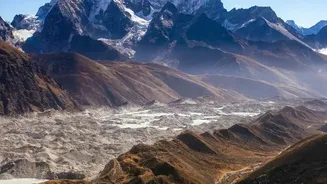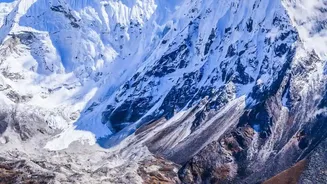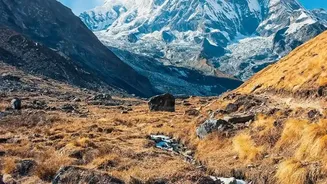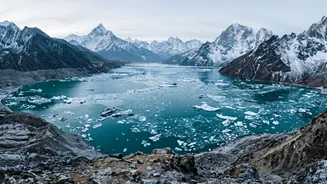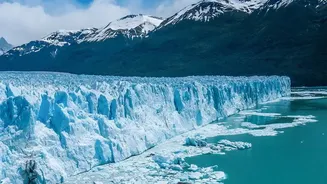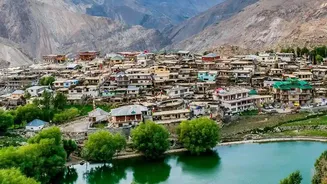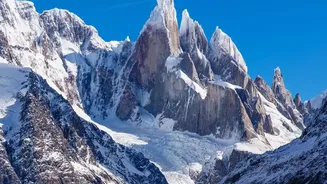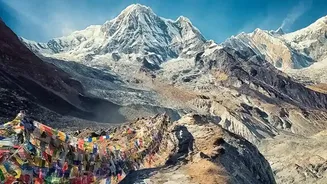







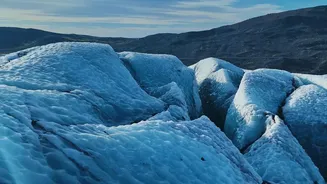
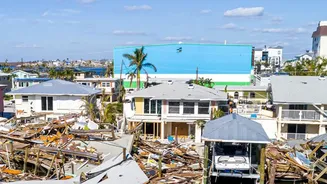
The serene, snow-capped peaks of the Himalayas conceal a growing threat. As glaciers melt at an alarming rate, new UN-backed reports warn of a dramatic increase in the risk of 'glacial lake outburst floods', a hidden danger for millions downstream.
What is a Glacial Lake Outburst Flood?
Imagine
a massive lake, larger than thousands of Olympic swimming pools, held back not by a concrete dam, but by an unstable wall of loose rock and ice. This is a moraine-dammed glacial lake, and it’s a direct consequence of climate change. As glaciers retreat, they leave behind vast depressions that fill with meltwater, dammed by the very debris the glacier pushed forward over centuries. A Glacial Lake Outburst Flood, or GLOF, is the sudden, catastrophic failure of this natural dam. It can be triggered by a landslide, an avalanche of ice into the lake, or simply the immense pressure of the water itself. The result is a terrifying wall of water, mud, and boulders that can surge down mountain valleys at immense speed, destroying everything in its path with little to no warning.
The UN's Grave Climate Warning
Recent reports released ahead of the UN's climate conference (COP31) paint a grim picture. Researchers have highlighted that the Hindu Kush Himalaya region, often called the 'Third Pole', is warming faster than the global average. This accelerated warming is causing glaciers to melt at unprecedented rates, leading to the rapid formation and expansion of glacial lakes. According to a study published in Nature, around 15 million people globally are at risk, with nearly three million in India and two million in Pakistan living in the shadow of these dangerous lakes. A separate UN-supported study found that between 1835 and 2025, India recorded the highest number of deaths from GLOFs among eight Himalayan countries, with over 6,000 fatalities. The frequency of these events has also increased, becoming roughly five times more common since 1950.
Who is at Risk in India?
The threat is not abstract; it looms over communities in several Indian states. The Himalayan regions of Sikkim, Uttarakhand, Himachal Pradesh, Arunachal Pradesh, Jammu and Kashmir, and Ladakh are particularly vulnerable. A recent disaster in October 2023 in Sikkim serves as a stark reminder. The breach of the South Lhonak lake triggered a flash flood in the Teesta river basin that claimed dozens of lives, left many more missing, and affected around 80,000 people across 100 villages. Hydropower projects, bridges, roads, and entire settlements lie in potential flood paths. Experts estimate that a significant percentage of the population in the northwestern Indian Himalayas lives on land highly vulnerable to GLOFs. The danger is often transboundary, as a recent GLOF from Bhutan's Shintaphu Lake triggered alerts and evacuations in downstream West Bengal and Assam.
Can These Mountain Tsunamis Be Prevented?
While stopping a GLOF entirely is incredibly difficult, its risks can be managed. The first step, as outlined by India's National Disaster Management Authority (NDMA), is identifying and mapping potentially dangerous lakes using satellite imagery and field studies. For high-risk lakes, engineering solutions can be deployed. These include controlled draining or siphoning of water to lower lake levels, constructing spillways to manage overflow, and reinforcing the natural moraine dams. However, these solutions are complex and expensive. A crucial element of mitigation is the establishment of robust early warning systems. By using sensors to monitor lake levels and seismic activity, authorities can provide downstream communities with critical evacuation warnings. Strengthening community preparedness through awareness programs and regular drills is equally vital, as local residents are often the first responders.