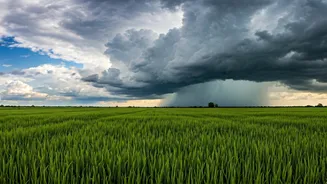









The Monsoon's Current Position
The much-awaited seasonal rains have decisively moved inland. The Northern Limit of Monsoon (NLM), the imaginary line marking its leading edge, has now passed through key areas of Maharashtra, including Mumbai, and has covered the entirety of coastal
Odisha. Recent IMD bulletins confirm the monsoon has enveloped most of Maharashtra, stretching into parts of Vidarbha, and has also advanced into regions of Chhattisgarh and southern Gujarat. This swift movement means millions of people who were grappling with extreme heatwaves are now experiencing cooler temperatures and the first heavy showers of the season.
What 'Rapid Progress' Actually Means
The term "rapid progress" isn't just a figure of speech; it describes a meteorological phenomenon. Typically, the monsoon's advance is a slow, methodical crawl. This year, however, favourable atmospheric conditions have acted as an accelerator. A key driver has been a persistent cyclonic circulation over the Bay of Bengal, which has been effectively 'pulling' the moisture-laden winds from the sea onto the landmass of Odisha and neighbouring states. Similarly, strong westerly winds and a developing low-pressure system in the Arabian Sea have helped the monsoon surge into Maharashtra, allowing it to cover areas in days that might normally take a week or more. This accelerated pace is a significant deviation from a staggered or delayed onset.
Impact on Maharashtra: Relief and Readiness
For Maharashtra, the monsoon's arrival is a story of dual realities. In Mumbai, the rains brought a welcome drop in temperature but also the familiar challenge of waterlogging and traffic disruptions. The Brihanmumbai Municipal Corporation (BMC) has been on high alert, activating contingency plans for potential flooding in low-lying areas. Beyond the metropolis, the monsoon's advance into the agrarian belts of Marathwada and Vidarbha is a lifeline. These regions are heavily dependent on rain-fed agriculture, and the timely arrival of the monsoon is crucial for the sowing of kharif crops like cotton, soybean, and pulses. For farmers, this rapid progress is a signal to begin their agricultural operations, a moment of immense economic significance.
The Situation in Odisha and the East
Along the eastern coast, Odisha has now been fully covered by the monsoon. The rains are vital for the state's paddy cultivation, which forms the backbone of its rural economy. The quick advance means that agricultural activities can commence without the stressful delays that sometimes plague the season. However, the IMD has also issued warnings for heavy to very heavy rainfall in several districts. This raises the risk of flash floods in coastal and southern parts of the state. Local authorities have been advising residents, particularly fishermen, to take necessary precautions. The monsoon's momentum in this region is also helping it push further into neighbouring Chhattisgarh and parts of West Bengal.
What to Expect Next
The IMD remains optimistic about the monsoon's continued journey. The prevailing conditions are expected to remain favourable for its further advance into the remaining parts of Chhattisgarh, Gujarat, and into states like Madhya Pradesh and Jharkhand over the coming days. The national weather agency is forecasting an active monsoon period, with widespread rainfall likely to continue across the newly covered regions. The focus now shifts to how well-distributed these rains will be. While a strong start is positive, the performance of the monsoon throughout July and August will be the true determinant of its success for the agricultural sector and for replenishing the country's water reservoirs.