




The Global Craze for Contrast
For decades, the conversation around food has been dominated by flavour. Is it sweet, sour, spicy, or umami? But increasingly, both diners and chefs are realising that a dish’s success hinges just as much on its ‘mouthfeel’—the physical sensation it creates.
The most memorable bites are often a symphony of textures. Think of a crispy-skinned fish on a bed of creamy polenta, or a soft taco with crunchy toppings. This pursuit of textural complexity is now a defining feature of modern cuisine. It’s the reason ‘crunch wraps’ go viral on social media and why fine-dining menus describe dishes with words like ‘crisp,’ ‘shatter,’ and ‘velvet.’ The goal is to create a dynamic, engaging eating experience that prevents palate fatigue and keeps the diner surprised from the first bite to the last. This isn’t just about adding a random crunchy element; it’s a deliberate, architectural approach to building a dish.
A Masterclass Already in Session
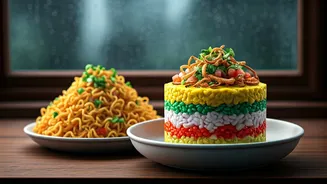
While Western chefs might be newly celebrating this concept, Indian cuisine is built on it. Our food culture is inherently multi-textural. We don’t need to invent it; we just need to recognise it. Consider the humble bhel puri. It’s a masterclass in contrast: the light crispness of puffed rice, the soft resistance of boiled potatoes, the sharp crunch of raw onion, the brittle snap of sev, and the liquid embrace of tamarind and mint chutneys. Or take dahi vada, where soft, spongy lentil dumplings are submerged in silky, cool yogurt, then topped with crunchy boondi and fine sev. Every spoonful is a different experience. The same principle applies to a perfect dosa—the shattering, paper-thin crisp of the exterior giving way to a soft, steamy potato filling, dipped in liquid sambar and creamy coconut chutney. This intuitive understanding of how textures play off each other is woven into the very fabric of our daily meals, from the crunch of a papad alongside soft dal and rice to the delightful surprise of a crispy-fried bhindi.
Beyond Flavour: The Next Frontier
Despite this rich heritage, modern Indian restaurant menus often focus overwhelmingly on flavour profiles, describing curries as ‘spicy,’ ‘creamy,’ or ‘tangy.’ Texture is treated as an afterthought, a happy accident rather than a key feature. This is a missed opportunity. As Indian cuisine continues its ascent on the global stage, its command of texture could be its most powerful differentiator. Chefs have the chance to move beyond simply recreating traditional dishes and start consciously amplifying their textural elements. Imagine a classic dal makhani, known for its creaminess, served with a ‘tadka’ that includes not just spices but crispy garlic chips, toasted pumpkin seeds, and crunchy fried lentils. Or a soft galouti kebab, famous for melting in the mouth, paired not with a simple paratha but with a crisp, delicate saffron wafer. By intentionally designing dishes around textural interplay, Indian chefs can offer a new lens through which to appreciate the complexity and sophistication of our cuisine.
Putting Texture on the Menu
So, how can Indian menus 'own' this trend? It starts with language. Instead of just listing ingredients, menus can actively describe the experience. A chaat could be described as a ‘multi-textural explosion of crisp, soft, and tangy.’ A fish curry could be highlighted as ‘velvety coconut gravy with flaky sea bass and a crisp curry leaf garnish.’ This small change helps educate the diner and sets expectations for a more dynamic meal. Secondly, chefs can innovate by deconstructing and reconstructing classic pairings. A raita doesn't just have to be yogurt; it can be a creamy base with pomegranate arils for a juicy pop and roasted cumin for a sandy crunch. A simple kheer can be elevated with brittle almond chikki or puffed amaranth for contrast. The components are already in our pantry. The challenge isn't to import a foreign trend, but to spotlight and amplify a strength that has always been central to Indian cooking.