

A Glimpse into a Dying Star's Ghost
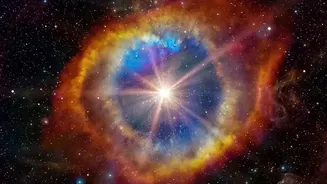
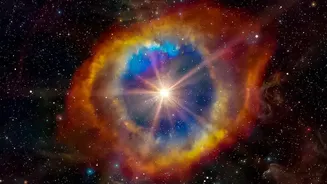
Located about 650 light-years away, the Helix Nebula is one of the closest and most famous examples of a planetary nebula. The name is a bit of a misnomer; it has nothing to do with planets. Instead, it’s the spectacular, glowing remains of a star that
was once like our own sun. In the final stages of its life, the star shed its outer layers of gas and dust into space. The central core of the star, now a super-hot white dwarf, illuminates this expanding shell, creating the intricate, colorful object that astronomers have studied for centuries. Its resemblance to a giant eye has earned it nicknames like the "Eye of God." Because of its relative proximity to Earth, it provides a unique laboratory for studying the end-of-life processes for sun-like stars.
Webb's Powerful Infrared Vision
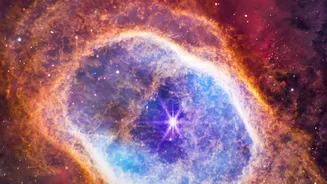
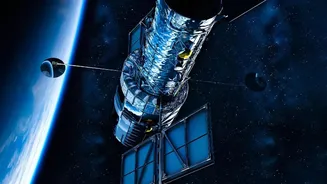
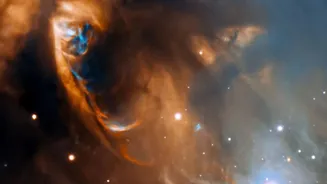
While previous telescopes like Hubble have captured breathtaking images of the Helix Nebula, the James Webb Space Telescope's ability to see in infrared light provides a completely new level of detail. Its recent observations have pierced through the outer layers of gas and dust, bringing thousands of previously hidden or blurry structures into sharp focus. These are the so-called "cometary knots," and Webb’s view has revealed an astonishing number of them—estimated to be as many as 40,000 in total. While astronomers knew these knots existed, the clarity and sheer volume seen by Webb offer the best-ever opportunity to finally understand them.
The Truth: They Are Not Comets
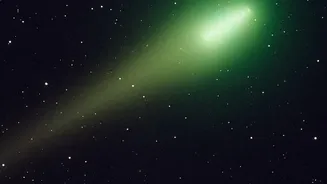
Despite their appearance, these structures are not comets. They are gigantic knots of molecular gas and dust. Each knot's dense "head" can contain a mass comparable to Earth's, but they are astronomically larger than our planet, with some heads being at least twice the size of our entire solar system. Their wispy "tails" stretch for incredible distances, some extending up to 100 billion miles. These are not icy bodies orbiting a star, but rather colossal clumps formed from the material ejected by the dying star itself. Their origin is still an active area of research, but the leading theory is that they form when hot, fast-moving gas from the central star collides with cooler, denser gas that was shed thousands of years earlier. This cosmic crash fragments the surrounding clouds into the dense droplets we see as knots.
So, Why the Comet Illusion?
The comet-like appearance is a trick of perspective and physics. The illusion is created by the intense ultraviolet radiation and powerful stellar winds blasting out from the central white dwarf. This energetic outflow slams into the dense, cooler knots of gas. The side of the knot facing the star glows brightly, forming the "head" of the apparent comet. The stellar wind then blows past the knot, eroding it and pushing a stream of less dense material away from the star, creating the long, faint tail. The process is remarkably similar to how the solar wind from our own sun strips material from a comet, forming its iconic tail. In both cases, a powerful stellar wind is creating a visible wake behind a denser object.
A Window into Our Sun's Future
Beyond solving a cosmic mystery, studying these cometary knots provides a fascinating preview of our own solar system's distant future. In about five billion years, our sun will exhaust its fuel and go through a similar process, shedding its outer layers to form its own planetary nebula. The intricate structures within the Helix Nebula, sculpted by stellar winds and radiation, show us the complex and beautiful chaos that accompanies the death of a star. By analyzing the size, shape, and distribution of these knots, scientists can better model how stars like our sun recycle their material back into the cosmos, providing the raw elements for the next generation of stars and planets. Webb's new view isn't just a pretty picture; it's a detailed look at the end of one star's life and the beginning of another cosmic cycle.