





What Is a Planetary Gathering?
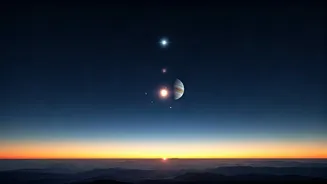
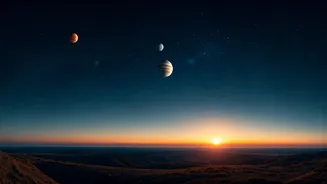
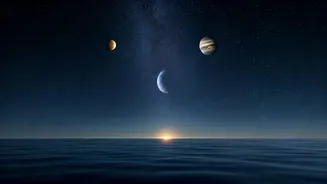
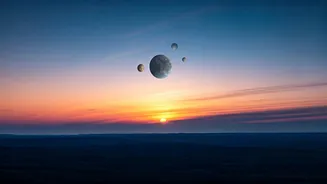
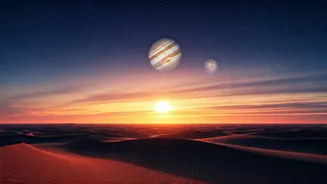
In the vastness of space, planets are constantly moving in their own orbits around the sun. From our perspective here on Earth, these paths sometimes appear to cross. When two or more planets appear very close to each other in our sky, it’s called a conjunction
or, more informally, a planetary 'gathering' or 'alignment'. It’s not that they are physically close to each other in space—they are still millions of kilometres apart. Instead, it’s a beautiful line-of-sight illusion. Getting to see three planets huddled together is a relatively rare treat for skywatchers, offering a unique chance to grasp the scale and movement of our solar system with just a simple glance upwards.
When and Where to Look
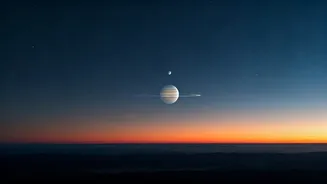
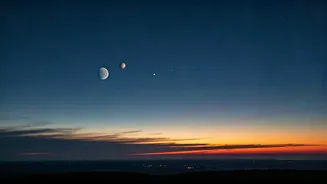
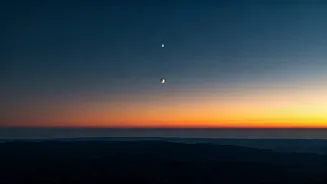
The key to catching this celestial trio is timing. The viewing window is short and specific: begin looking toward the western horizon about 30 to 45 minutes after the sun has fully set. This is during twilight, when the sky is dark enough to see the planets, but before they have dipped below the horizon themselves. Because Mercury always stays close to the sun in our sky, the entire formation will be very low. Any later, and they will have set. This event is visible for several consecutive evenings, but the spacing and orientation of the planets will change slightly each night as they continue their cosmic dance. Check your local sunset time and get ready for a brief but brilliant show.
How to Identify Each Planet
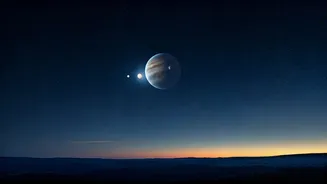
You won't need a star chart to find the brightest member of the trio. Venus will be unmistakable. Often called the “Evening Star,” it shines with a brilliant, steady, silver-white light and will be the brightest object in that patch of sky. Not far from it, you’ll find Jupiter. While not as dazzling as Venus, Jupiter is still one of the brightest objects in the night sky, shining with a strong, unwavering golden-hued light. The real challenge is spotting Mercury. It will be the faintest of the three and positioned closest to the horizon, often lost in the sunset’s glow. Look for a tiny, star-like point of light just below or beside the other two. Finding it is a rewarding moment for any stargazer.
Tips for the Best Viewing Experience
You don't need any expensive equipment for this. The most important thing is a clear, unobstructed view of the western horizon. Head to a rooftop, a park, or a field away from tall buildings and bright city lights. The darker your surroundings, the better your chances of spotting faint Mercury. Give your eyes at least 10-15 minutes to adjust to the darkness; avoid looking at your phone screen during this time. While you don’t need a telescope, a pair of binoculars can dramatically enhance the view. They will make Mercury much easier to spot and might even reveal Jupiter’s four largest moons, which look like tiny pinpricks of light flanking the planet. Finally, check the weather forecast. Clear skies are essential!
The Science Behind the Spectacle
This beautiful alignment is a simple matter of orbital mechanics. Earth, Mercury, Venus, and Jupiter are all orbiting the sun at different speeds and distances. As we all move, our vantage point changes. This gathering occurs when Earth is in a position where Venus, Mercury, and Jupiter fall into the same narrow line of sight for us. Mercury, being the innermost planet, moves fastest and never strays far from the sun in our sky. Venus, the next one out, is also an 'inferior' planet, meaning it's confined to the morning or evening sky. Jupiter, an 'exterior' gas giant, has a much wider path across our sky. Seeing them all converge in the same small area after sunset is a happy coincidence of their different orbital paths lining up just right.