
An Annual Planetary Health Check
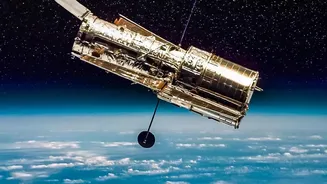
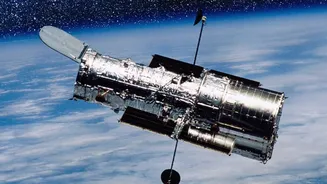
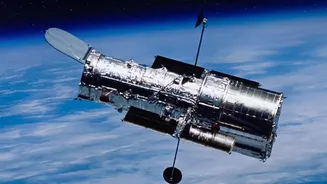
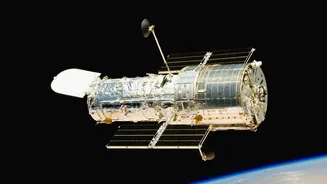
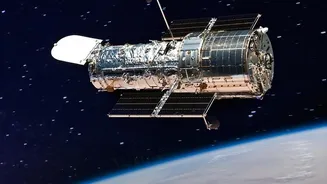
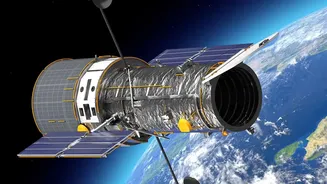
Imagine trying to understand Earth's climate by looking at a single weather report. It’s impossible. You need consistent data over a long period. That's the idea behind the Outer Planet Atmospheres Legacy (OPAL) program. Since 2014, Hubble has been dedicated
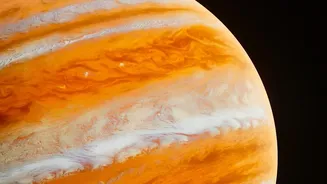
to taking yearly snapshots of our solar system's outer giants: Jupiter, Saturn, Uranus, and Neptune. For Saturn, this annual check-up began in 2018, providing a continuous stream of high-resolution images. This regular monitoring allows scientists to move beyond static photos and instead track long-term trends, turning individual images into a coherent story of atmospheric evolution. This consistent, long-term data is crucial because the planets' atmospheres are incredibly dynamic, and without a regular watch, scientists can miss key evolutionary cycles.
Tracking the Seven-Year Seasons
A year on Saturn lasts for more than 29 Earth years, which means each of its seasons is over seven Earth years long. Just like Earth, Saturn is tilted on its axis, so this tilt causes significant seasonal changes. Hubble's OPAL program is powerful because it watches these slow, colossal shifts unfold. For instance, as Saturn’s northern hemisphere moved through its summer and into autumn, Hubble documented changes in the atmospheric colour bands. Increased sunlight during the summer seems to create a reddish haze, possibly by altering atmospheric circulation or the amount of photochemical haze produced. As winter approaches in a hemisphere, that region can take on a bluer hue as the haze dissipates without direct sunlight. Tracking these subtle colour shifts from year to year gives scientists clues about the chemical and physical processes driven by the changing seasons.
Investigating Mysterious Storms and Jets
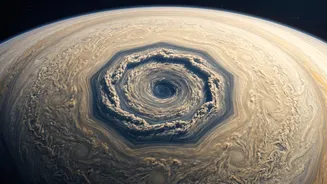
Saturn's atmosphere isn't just about gentle seasonal shifts; it's home to powerful storms and strange jet streams. Hubble's sharp vision allows it to spot small, transient storms that pop up and disappear between yearly observations. But it has also helped uncover much larger, more bizarre phenomena. For decades, scientists have known about a massive, six-sided jet stream at Saturn's north pole, known as the hexagon. More recently, in 2023, Hubble data revealed the formation of a new, 10-sided pattern—a decagon—around the south pole. This was a surprise, as the Cassini spacecraft, which orbited Saturn from 2004 to 2017, saw no such long-lived formation. Observing the birth and evolution of a new, giant atmospheric wave gives scientists a rare chance to understand the forces that create and sustain these massive weather patterns.
It's Raining Rings
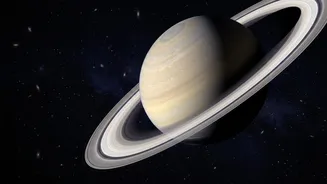
One of the most fascinating discoveries involves the planet's iconic rings. They aren't just orbiting debris; they actively influence Saturn's weather. Evidence from Hubble and other missions has shown that icy particles are raining down from the rings into the planet's atmosphere. This influx of material heats the upper atmosphere, causing an excess of ultraviolet radiation that Hubble’s instruments can detect. This 'ring rain' could be caused by several things, including impacts from micrometeorites or bombardment by solar wind particles. By combining decades of data, scientists used Hubble's precision to confirm this phenomenon, solving a long-standing mystery and revealing a surprising connection between the rings and the planet's weather system.
A Laboratory for Other Worlds
Studying the weather on a gas giant 1.4 billion kilometres away might seem abstract, but it has profound implications. Saturn serves as a natural laboratory for understanding the physics of atmospheres under extreme conditions. The lessons learned from its powerful winds and massive storms help scientists build better models for Earth's own climate systems. Furthermore, many of the planets discovered orbiting other stars—exoplanets—are gas giants like Saturn. By understanding the mechanics of our solar system's giants, we get a crucial reference point for interpreting the atmospheres of these distant worlds and figuring out the conditions that might exist there.