


A Universe in a Hurry
Imagine a time when the entire cosmos was a frenetic construction zone. This was our universe about 10 to 11 billion years ago, an era astronomers call 'cosmic noon'. During this period, galaxies were forming stars at rates dozens or even hundreds of
times faster than our Milky Way does today. These intensely productive galaxies, known as 'starburst galaxies', were common, churning out massive, hot, bright stars. However, this frantic activity was often hidden from view, shrouded by enormous clouds of cosmic dust that absorbed the starlight, making these galactic engines nearly invisible to traditional telescopes. This has long posed a challenge for scientists trying to piece together a complete picture of how the first galaxies grew and evolved.
Enter the Ghost Particle
To see inside these dusty cauldrons, astronomers needed a different kind of messenger—one that could pass through dust, gas, and even entire planets as if they were not there. This messenger is the neutrino. Neutrinos are fundamental particles with almost no mass and no electric charge, earning them the nickname 'ghost particles'. They are produced in extreme cosmic events, including the violent processes inside starburst galaxies. While light gets trapped by dust, neutrinos stream out unimpeded, carrying direct information from the heart of the action across billions of light-years. The catch? Their elusive nature makes them incredibly difficult to detect. It requires detectors of monumental scale, like the IceCube Neutrino Observatory buried in a cubic kilometre of Antarctic ice, to catch the faint flashes they produce when they finally interact with matter.
Decoding the 'Shadow Blaster'
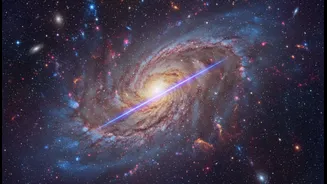
On September 22, 2021, IceCube detected a single, extremely high-energy neutrino. Tracing its path back across the cosmos, astronomers pinpointed a likely source: a distant, dusty starburst galaxy nicknamed the 'Shadow Blaster'. Officially designated JCMT0402−0424, this galaxy is a perfect candidate for a neutrino factory. Unlike other known neutrino sources that are powered by supermassive black holes, observations suggest the Shadow Blaster's energy comes from its intense star formation. The galaxy has a dense, compact core packed with gas where cosmic rays—high-energy particles accelerated by supernova explosions—repeatedly slam into surrounding material, producing a shower of secondary particles, including neutrinos. This makes it a prime example of the exact type of galaxy that was common during cosmic noon.
Why This Discovery Matters
The identification of the Shadow Blaster as a neutrino source is a landmark moment in multi-messenger astronomy, where scientists combine signals from different cosmic messengers like light and particles. It provides the first strong observational evidence that dusty, star-forming galaxies are indeed significant contributors to the universe's overall high-energy neutrino background. While a single galaxy like this one produces a modest number of detectable neutrinos, the key insight is that there were countless such galaxies in the early universe. As a population, these compact starbursts could account for up to 20% of all the high-energy neutrinos that IceCube observes, helping to solve a long-standing mystery about their origins. This discovery effectively gives astronomers a new tool to study the most productive and most obscured phase of galaxy formation in cosmic history.