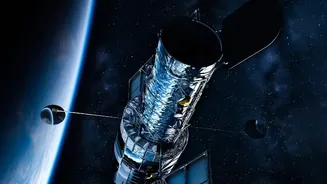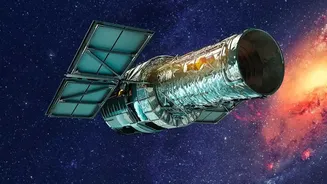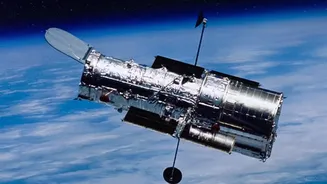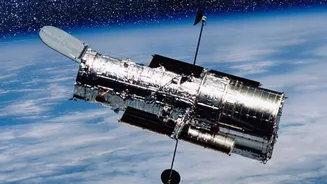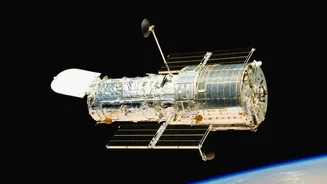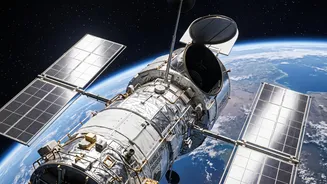




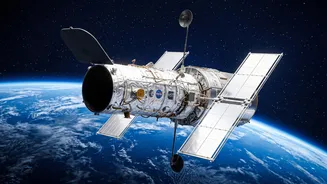

For over 35 years, the Hubble Space Telescope has been humanity's eye on the cosmos, delivering breathtaking images and revolutionary science. But a persistent, quiet force is threatening its mission: orbital decay. Now, NASA is turning to the commercial
space industry for a potential solution.
A Slow But Steady Descent
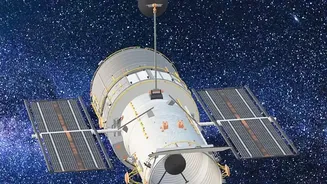
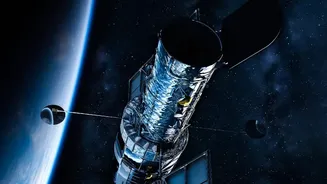
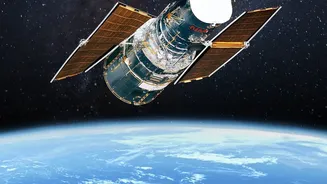
Hubble doesn't have an engine to keep itself in a stable orbit. It circles the Earth in low-Earth orbit, where the atmosphere is incredibly thin but not entirely absent. This faint atmospheric drag acts like a gentle but constant brake on the school bus-sized observatory, causing it to gradually lose altitude. This process, known as orbital decay, has accelerated recently due to higher-than-expected solar activity, which causes the upper atmosphere to swell. Currently, Hubble's orbit is decaying by about 14.3 kilometers per year. While there's no immediate danger, NASA projects that without intervention, the telescope will re-enter Earth's atmosphere sometime between 2033 and 2034.
NASA Opens the Door for Ideas
In response to this looming deadline, NASA issued a formal 'Request for Information' (RFI) on October 29, 2026. This isn't a contract for a mission but rather a way for the agency to survey the landscape of the commercial space sector. NASA is asking private companies to propose innovative and cost-effective concepts for three potential scenarios: boost Hubble to a higher, more stable orbit; service the telescope with potential upgrades; or perform a safe, controlled de-orbit to dispose of it at the end of its life. The deadline for responses is November 30, 2026, giving the industry a month to present its capabilities.
Who Could Answer the Call?
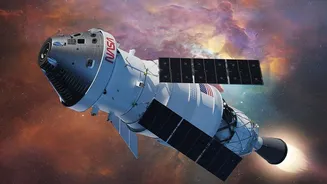
The RFI is open to any company, but a few names immediately come to mind. SpaceX, in partnership with billionaire Jared Isaacman's Polaris Program, previously entered an unfunded agreement with NASA in 2022 to study the feasibility of using a Dragon spacecraft to service Hubble. While that specific plan seemed to stall due to concerns over technical readiness, the new, broader RFI might revive interest. Other companies specializing in in-space servicing, such as Northrop Grumman with its Mission Extension Vehicle (MEV) or startups like Astroscale, could also present robotic solutions. The key challenge for any provider will be to safely rendezvous with and capture a telescope that was not designed for modern commercial docking.
What a 'Reboost' Mission Entails
The most discussed option is a 'reboost' mission. This would involve a commercial spacecraft flying to Hubble, matching its orbit, and then physically pushing it into a higher altitude. The last time Hubble's orbit was raised was in 2002 by the Space Shuttle Columbia. A new boost to an altitude of 600 kilometers could add another 15 to 25 years to the telescope's operational life. This could be done robotically, with a servicing 'tug' that latches on and fires its thrusters, or potentially via a crewed mission, though that presents greater complexity and risk. The RFI specifies that the provider would be responsible for the entire mission, including the rocket, spacecraft, and operations.
A New Model for Sustaining Space Assets
This situation represents a major shift in how legacy space assets are managed. With the Space Shuttle retired, NASA no longer has its own vehicle for handson servicing missions of this kind. Turning to the private sector isn't just a potential solution for Hubble; it's a test case for the future. Can the burgeoning commercial space industry, which has excelled at launching satellites and ferrying astronauts to the International Space Station, prove it can also perform complex servicing on highvalue scientific instruments? Answering this call could open up a new market for extending the lives of valuable satellites, while preserving Hubble's unique ability to observe the universe in ultraviolet and visible light—a capability its successor, the James Webb Space Telescope, does not replicate.