



The New Creative Co-Pilot
For decades, turning a rough idea into a polished visual was a labor-intensive process. It required skilled artists, photographers, or graphic designers, specialized software, and often, days or weeks of work. You started with a sketch, a mood board,
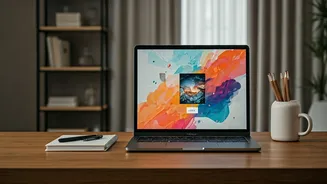
or a lengthy search through stock photo libraries. Generative AI tools have completely upended that workflow. Now, anyone with an idea can describe it in plain English and receive a dozen visual interpretations in under a minute.Think of it as a creative co-pilot with an encyclopedic knowledge of art history, photography, and design. You provide the conceptual direction—the 'what'—and the AI handles the technical execution—the 'how.' This technology doesn’t just create collages from existing images; it generates entirely new pixels from scratch, based on patterns learned from analyzing billions of image-text pairs from the internet. The result is a powerful tool for brainstorming, rapid prototyping, and creating final assets that were once prohibitively expensive or time-consuming to produce.
From Text Prompt to Polished Picture
So, how does it actually work? At the heart of leading models like OpenAI's DALL-E 3, Midjourney, and the open-source Stable Diffusion are complex neural networks. When you type a prompt like, “A photorealistic image of a vintage red convertible driving along the Amalfi Coast at sunset, golden hour lighting,” the AI doesn't 'understand' the sentence like a human. Instead, it translates those words into a mathematical concept and then begins a process called diffusion.It starts with a field of random digital noise—like static on an old TV screen—and methodically refines it, step by step, to match the concept described in your prompt. It’s like a sculptor who starts with a formless block of marble and chips away everything that doesn't look like the final statue. The AI chips away the noise, adding color, texture, and form until the specified image emerges. The “high quality” aspect comes from the immense dataset it was trained on, allowing it to convincingly replicate specific photographic styles, lighting conditions, and even the nuances of a particular artist’s brushstrokes.
Accelerating the Speed of Imagination
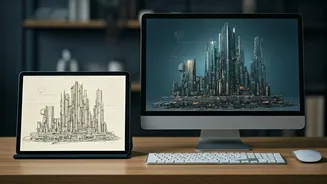
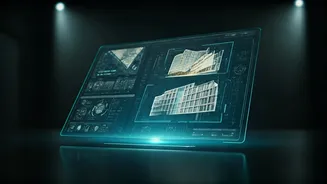
The word “instantly” in the headline is a slight exaggeration, but only slight. Instead of waiting a week for a designer to return with three concepts, a marketing director can now generate 30 variations in 15 minutes. This speed is unlocking new possibilities across industries. Advertising agencies are using AI to visualize campaign ideas for client pitches, moving from abstract descriptions to concrete visuals in a single meeting. Architects and interior designers are generating realistic renderings of spaces to help clients make decisions faster. Independent game developers are creating vast worlds of concept art and textures without needing a massive art department.This isn't just about saving time and money; it's about expanding creative exploration. When the cost of trying a new idea drops to nearly zero, people try more ideas. A creative team can explore wilder, more ambitious concepts, knowing they can quickly see if they work visually without committing significant resources. The bottleneck is no longer the execution, but the quality and originality of the initial concept.
Not Magic, But a New Kind of Skill
While these tools lower the barrier to creating visuals, they don't eliminate the need for skill. The craft is simply shifting. Instead of mastering a paintbrush or Adobe Photoshop, the key skill is now “prompt engineering”—the art and science of writing text descriptions that guide the AI toward the desired output. A weak prompt yields generic, often bizarre results. A great prompt is specific, nuanced, and understands how the AI interprets language.It involves more than just descriptive words. Expert users specify camera lenses, film types, lighting setups, and artistic movements. They iterate, refining their prompts to tweak a composition or adjust a color palette. They often use multiple tools, generating a base image in one AI and then using other software for touch-ups. Far from being an instant “push-button” solution for perfect art, generative AI is a powerful instrument that rewards practice, taste, and a deep understanding of visual language. The artist's role evolves from a creator of pixels to a curator of possibilities and a director of the AI.