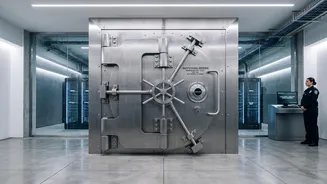








The cryptocurrency world was shaken by reports of a staggering $6.3 billion theft from Binance, the industry's largest exchange. This wasn't just another hack; it represents the biggest crypto heist in history. The attack has been attributed to a sophisticated,
months-long campaign involving compromised internal systems.
A Sophisticated, Months-Long Campaign
This wasn't a simple case of a single mistake. According to a detailed post-mortem released by Binance, the security incident was the result of a highly sophisticated, multi-stage campaign that unfolded over several months. The operation began as early as June 2026, when an engineer inadvertently downloaded malicious software disguised as a popular AI coding tool. Although Binance's security team detected this and replaced the device, the attackers had already gained crucial information about the company's wallet infrastructure team. This initial foothold paved the way for a more targeted attack involving social engineering, where another engineer was approached via a legitimate job-hunting platform and lured into fake interviews. During this process, the employee was tricked into downloading malware, giving the attackers deeper access.
The Compromised Internal System
The attackers leveraged their access to compromise an internal AI tool, which they then used to take control of multiple engineers' computers. The final stage of the attack, which took place on October 29, 2026, saw the hackers use their accumulated access and a stolen deployment token to trigger unauthorized transactions. Crucially, they didn't steal the private keys to Binance's main wallets. Instead, they compromised the exchange's hot wallet 'signing' infrastructure. This system is responsible for authorising transactions. The attackers essentially tricked Binance's own systems into signing and approving the massive withdrawals, moving approximately $6.36 billion across ten different blockchains in about 20 minutes.
Putting the Heist in Perspective
The scale of the Binance hack is unprecedented, dwarfing all previous cryptocurrency thefts. At roughly $6.3 billion, it is more than four times larger than the previous record holder, a $1.5 billion heist from the Bybit exchange in 2025. Other major historical hacks, such as the $625 million theft from the Ronin Network in 2022 and the $611 million Poly Network incident in 2021, are now footnotes by comparison. Blockchain intelligence firm TRM Labs described the event as 'almost certainly the single largest-known theft of any kind'. The attack has been widely attributed by the FBI and several blockchain analytics firms to TraderTraitor, an elite hacking unit linked to North Korea, though North Korea has denied involvement.
Binance's Response and Market Reaction
Binance responded swiftly by suspending all deposits and withdrawals to contain the breach. The exchange's team then worked with partners, including stablecoin issuers Tether and Circle, to freeze a significant portion of the stolen assets. Approximately $3 billion of the stolen funds were successfully frozen or intercepted through these coordinated efforts. In the immediate aftermath, the market reacted with predictable panic, with Bitcoin's price briefly dropping. Despite the shock, Binance's co-CEO, Richard Teng, assured the public that all user losses would be fully covered by the company, using its Secure Asset Fund for Users (SAFU) and its own corporate funds. Withdrawals have since resumed in phases. In the days following, the exchange saw significant outflows as users reacted to the news, though the company stated that activity later stabilised.