


India’s Next Interplanetary Frontier
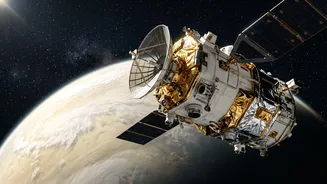
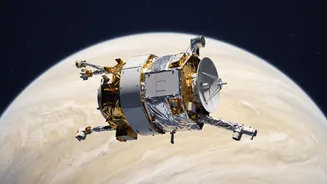
After the historic successes of the Chandrayaan moon missions and the Mangalyaan Mars orbiter, ISRO is setting its sights on the second planet from the sun: Venus. The upcoming Venus Orbiter Mission, unofficially known as Shukrayaan, marks India's first
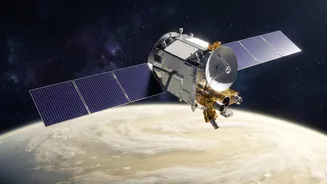
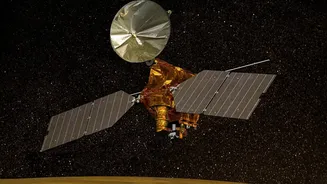
dedicated mission to our closest planetary neighbour. Scheduled for a March 2028 launch aboard the powerful LVM-3 rocket, the same launcher as Chandrayaan-3, the mission represents a major step in India's planetary exploration ambitions. The spacecraft will embark on a 112-day journey before entering a carefully planned elliptical orbit around Venus to begin its four-year scientific investigation.
Why Study Earth's 'Evil Twin'?
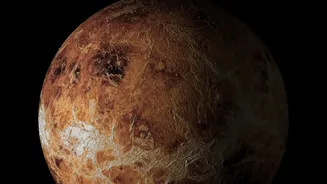
Venus is often called Earth's twin due to its similar size, mass, and density. However, the similarities end there. Venus is the hottest planet in our solar system, with a runaway greenhouse effect creating surface temperatures that can melt lead, an atmosphere 90 times denser than Earth's, and clouds made of corrosive sulfuric acid. Scientists believe Venus may have once had liquid water and a more temperate climate, similar to early Earth. Understanding what caused Venus to evolve into such a hostile inferno is a key scientific puzzle. Studying this 'evil twin' can provide invaluable insights into how planetary climates evolve, offering lessons on climate change processes that could be relevant to our own planet's future.
The Special Sensors to Pierce the Veil
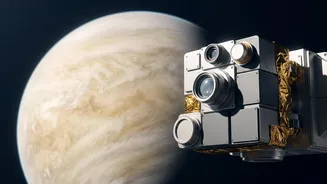
The headline-making feature of the Shukrayaan mission is its suite of advanced sensors, designed to study Venus from its surface to its upper atmosphere. A key instrument is a high-resolution Synthetic Aperture Radar (SAR), designed to penetrate the planet's thick, opaque clouds and map the surface in detail. This will allow scientists to look for signs of active volcanoes and other geological processes. The mission will also carry instruments to specifically analyze the atmosphere. These include spectrometers to study the composition of the dense carbon dioxide atmosphere and the dynamics of the mysterious super-rotating winds. International collaborations are also key, with a Swedish-built instrument, the Venusian Neutrals Analyzer (VNA), set to study how charged particles from the sun interact with the planet's atmosphere. France and Russia are contributing to the Venus Infrared Atmospheric Gases Linker (VIRAL) instrument to analyze atmospheric chemistry.
What Mysteries Will Shukrayaan Solve?
The mission's objectives are ambitious. By studying the surface and the processes that shaped it, ISRO hopes to understand Venus's geological history. The atmospheric sensors will be crucial for decoding the planet’s extreme greenhouse effect and complex weather patterns. One of the most intriguing goals is the investigation of the interaction between the solar wind and Venus's ionosphere, which could explain how the planet lost its water over billions of years. The orbiter will also carry a Lightning Instrument for Venus (LIVE) to detect and analyze electrical activity, providing clues about atmospheric dynamics. The comprehensive data gathered by these specialized instruments will help build a complete picture of Venus, from its hidden surface to the top of its toxic clouds.