


The Rise of the Digital Creator
We are living in an era of unprecedented digital creation. With just a few text prompts, generative AI tools can produce complex legal arguments, draft marketing copy, paint surrealist landscapes, and even compose symphonies in the style of long-dead
masters. This explosion of AI-generated content has been both astonishing and unsettling. It has democratised access to creative tools, allowing anyone to visualise an idea or articulate a thought with the help of a powerful algorithm. The results are often polished, coherent, and sometimes, genuinely surprising. This has firmly established that AI can, in a very real sense, create. It can assemble and produce novel artifacts that did not exist before. But the ease and speed of this creation also raise a fundamental question about the process itself.
How AI Actually 'Creates'
To understand AI's limits, we need to look under the hood. Generative AI doesn't think or feel; it calculates. Models like ChatGPT or Midjourney are trained on colossal datasets of text and images created by humans. They learn to recognise and replicate patterns, styles, and structures within this data. When you ask AI to create something, it isn't inventing from a place of inspiration. Instead, it is engaging in a highly sophisticated act of statistical recombination. It predicts the most probable next word in a sentence or pixel in an image based on the patterns it has learned. The output might be original in the sense that the exact combination has never existed before, but the building blocks are all drawn from its training data. It is a master remixer, a brilliant mimic, but it operates without genuine understanding of the content it produces.
The Uniquely Human Element: Imagination
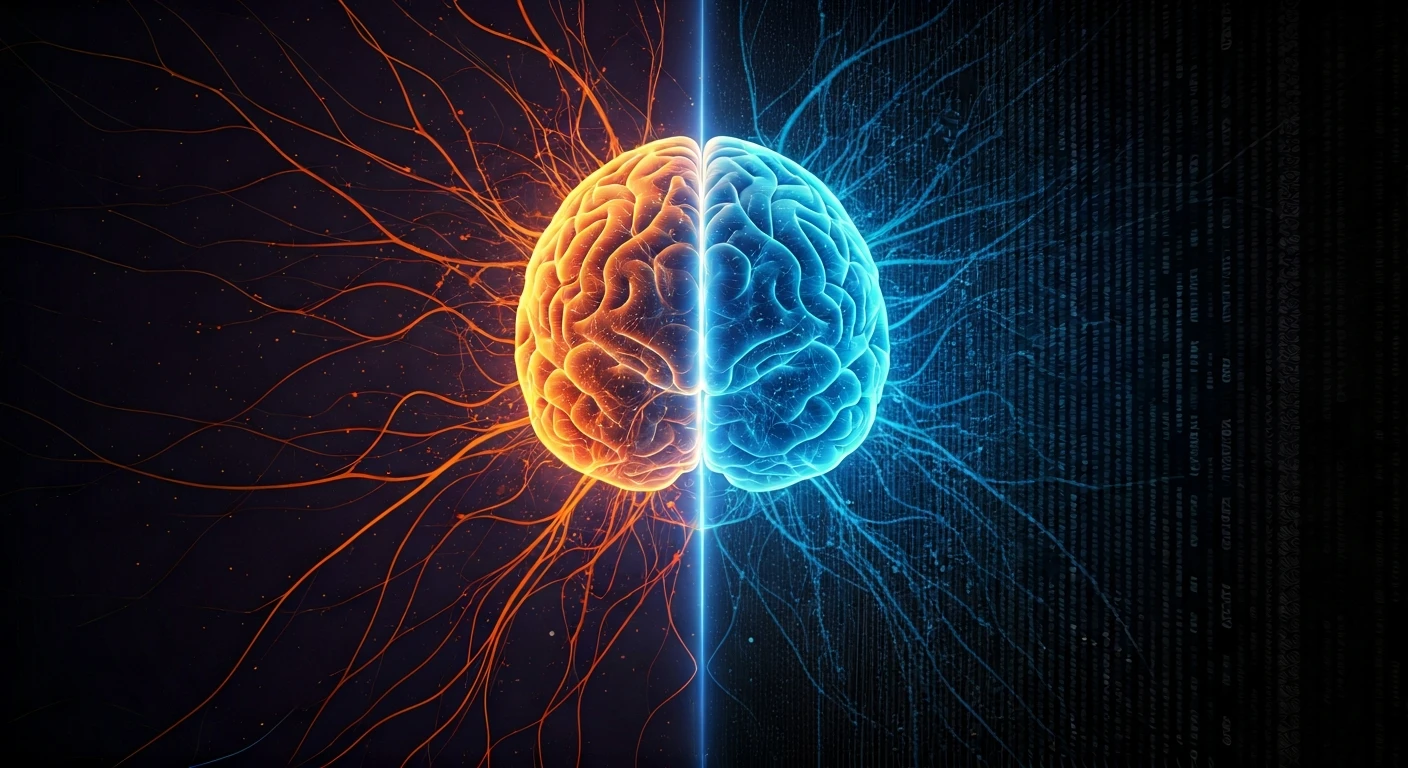
Human imagination works on a different plane. It isn't just about remixing what we’ve already seen or heard. It is deeply intertwined with our consciousness, our lived experiences, our emotions, and our intentions. When a human artist creates, they draw from a well of personal memories, feelings of joy or sorrow, cultural context, and a desire to communicate a specific message or feeling. Imagination is about more than just generating new combinations; it's about envisioning possibilities, asking "what if?", and connecting disparate ideas through intuition and subjective experience. It is this internal, experience-based world that AI completely lacks. An AI has never felt the warmth of the sun, the pain of a loss, or the thrill of a new discovery—the very things that fuel the most profound human art.
The Missing Ingredients: Consciousness and Intent
The core difference boils down to consciousness and intent. An AI does not have a “why.” It creates because it was prompted to, executing a command based on its programming. There is no inner drive, no burning need to express a personal truth. True creativity is often driven by intention—the artist wants to challenge a social norm, express love, or explore a philosophical question. AI, by contrast, has no beliefs, no perspective, and no agency. It cannot imbue its work with genuine meaning because it does not understand meaning itself. While studies show AI can sometimes outperform the average person on simple creativity tasks, the best human creators consistently come out on top, precisely because their work is infused with these uniquely human elements.
A Powerful Tool, Not a Replacement Muse
Rather than viewing AI as a rival creator, it's more accurate to see it as an incredibly powerful new tool—the next step after the camera or the synthesizer. It can serve as a collaborator, helping artists, writers, and designers brainstorm ideas, overcome creative blocks, and automate tedious parts of the creation process. A musician might use AI to generate a dozen different chord progressions, then use their human expertise and taste to select one and build an emotionally resonant song around it. In this partnership, the AI provides the raw material, but the human provides the vision, taste, and emotional depth. The future of creativity likely isn't a battle between humans and machines, but a collaboration where AI augments our own imaginative capabilities.