
The Cosmic Connection Problem
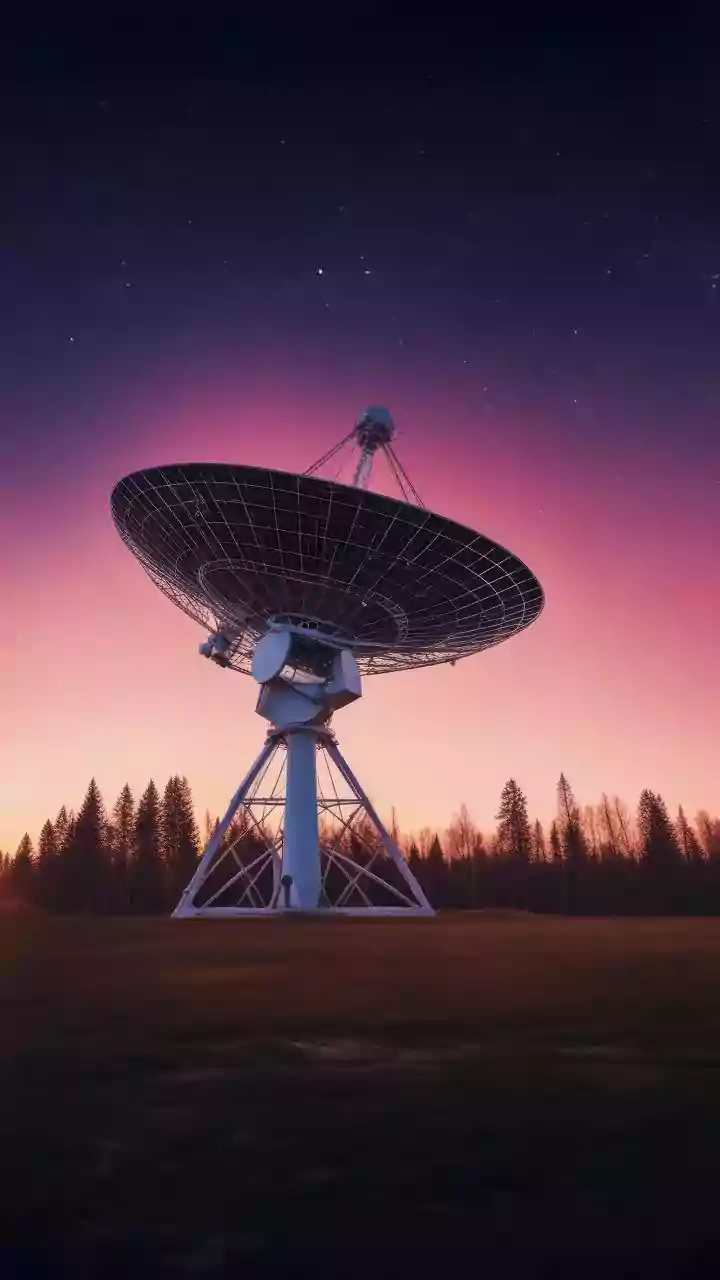
Since the dawn of the space age, humanity has relied on radio waves to talk to its robotic and human explorers. This method, managed by networks like NASA's Deep Space Network (DSN), has been reliable, bringing us iconic images from the Moon and data
from the farthest reaches of our solar system. However, radio frequency communication has a fundamental limitation: bandwidth. As scientific instruments become more sophisticated, capturing vast amounts of high-resolution data, the radio wave pipeline has become a bottleneck. Sending a single high-resolution image from Mars, for instance, could take hours, and streaming live video was pure science fiction. This data traffic jam has limited the pace of discovery and the potential for real-time interaction with deep space missions.
A Breakthrough Built on Light
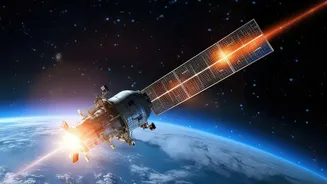
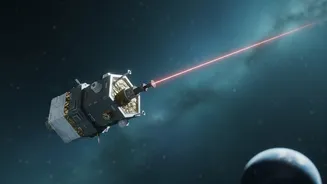
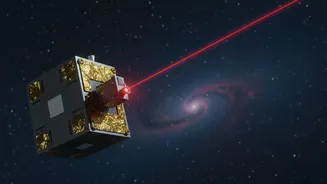
The solution is to move up the electromagnetic spectrum from radio waves to light itself. Specifically, near-infrared light, which is invisible to the human eye. This technology, known as free-space optical communications (FSOC) or simply laser communications, works on the same basic principle as fibre optic internet on Earth, but without the cables. By encoding data onto laser beams, engineers can pack far more information into each transmission. This allows for data rates that are 10 to 100 times greater than the most advanced radio systems, all while using hardware that can be smaller, lighter, and more power-efficient—three critical metrics for anything launched into space.
Hitting a Target Millions of Kilometres Away
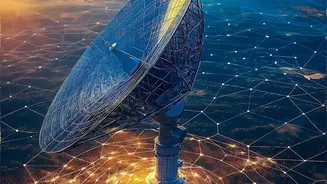
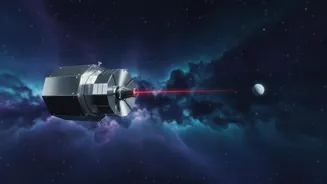
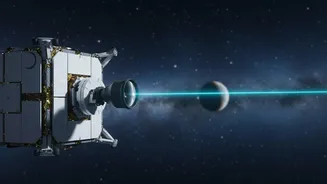
The primary challenge of laser communications is its incredible precision. Unlike radio waves that spread out widely, laser beams are extremely narrow. Successfully sending and receiving a signal requires pointing a laser from a speeding spacecraft with microradian accuracy—equivalent to hitting a ten-rupee coin from a kilometre away—to a telescope on Earth. NASA's Deep Space Optical Communications (DSOC) experiment, flying aboard the Psyche spacecraft, has proven this is possible. The system uses a ground-based 'uplink' laser from Earth as a beacon, which the spacecraft's transceiver locks onto. It then transmits its own high-speed 'downlink' beam back to highly sensitive detectors on Earth, which can count individual photons.
From Dial-Up Speeds to Deep Space Broadband
The results from the DSOC experiment have been nothing short of revolutionary. In one of its early tests, it streamed a 15-second, high-definition video of a cat named Taters from 31 million kilometres away. The data was transmitted at a staggering 267 megabits per second (Mbps), a rate comparable to terrestrial broadband internet. For comparison, the best radio systems at similar distances typically manage less than 1 Mbps. Even as the Psyche spacecraft travelled farther out, to distances comparable to Mars's farthest point from Earth, the system maintained impressive speeds, far surpassing traditional radio links. This demonstration has effectively proven that high-bandwidth communication is now a viable technology for interplanetary missions.
A New Era for Exploration and Science
This leap in communication speed will transform space exploration. It paves the way for future crewed missions to Mars, which will require reliable, high-speed links for exchanging large video files and data to keep astronauts safe and missions on track. For robotic missions, it means scientists can receive ten times more data, or even more, from their instruments. This could unlock new discoveries, allowing for more complex experiments and near real-time analysis of images and video from other worlds. We could one day watch a rover explore a Martian canyon in high-definition or see astronauts walk on the red planet, all streamed live. This isn't just an upgrade; it's the foundation for a true solar system internet, connecting Earth to our outposts on the Moon, Mars, and beyond.