





An Ocean World in the Crosshairs
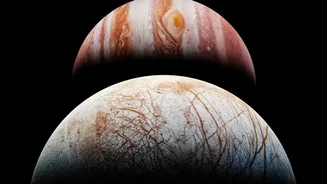
For decades, scientists have gathered mounting evidence that Europa, a world slightly smaller than Earth's moon, hides a global ocean that could contain more than twice the water in all of Earth's oceans combined. This makes it one of the most promising
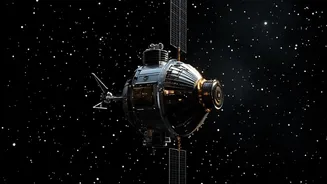
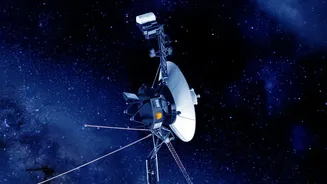
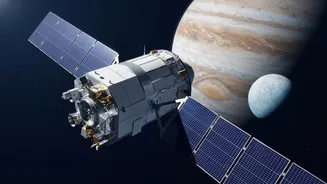
places to search for environments that could support life. Launched in October 2024, the Europa Clipper mission is NASA's most ambitious journey to an ocean world. It isn't looking for life itself, but rather to understand if this moon has the necessary ingredients for it: water, chemistry, and energy. To do this, the spacecraft will perform dozens of close flybys, some as low as 25 kilometers, using a suite of nine advanced instruments to scan and scrutinize the moon.
REASON: The Eyes That See Through Ice
Of all the high-tech gear aboard the Clipper, one instrument stands out for its unique ability to do what no other can: look directly through Europa's ice. It's called REASON, short for Radar for Europa Assessment and Sounding: Ocean to Near-surface. This sophisticated ice-penetrating radar is designed to be the mission's star detective, sending radio waves deep into the moon's crust to find the boundary between the ice and the liquid water below. Developed by researchers with experience studying Antarctica's ice sheet, REASON is tasked with mapping the hidden, three-dimensional structure of the ice shell for the first time. Its primary goals are to confirm the ocean's existence, measure the thickness of the ice, and search for pockets of trapped liquid water that could be crucial for understanding how the surface and ocean might exchange materials.
How the Dual-Frequency Radar Works
REASON operates by sending out radio signals and analyzing the echoes that bounce back. By measuring the time it takes for a signal to return, scientists can determine the depth of various features. But to get a complete picture, the instrument uses a clever dual-frequency approach. It transmits both high-frequency (VHF) and very-high-frequency (HF) radio waves, at 60 MHz and 9 MHz, respectively. Think of it like having two different kinds of vision. The higher-frequency 60 MHz waves are excellent for creating detailed maps of the upper layers of the ice and searching for shallow features, like pockets of brine. The lower-frequency 9 MHz waves are the deep divers; they are designed to penetrate as far as 30 kilometers down to detect the signature of the deep subsurface ocean.
The Search for More Than Just an Ocean
While finding the ocean is the main event, REASON's data will provide a wealth of other information. By mapping the ice shell's structure, it will help scientists understand the moon's geology and whether there are active processes, such as plumes or cryovolcanism, that could be transporting ocean material to the surface. The instrument can also characterize the roughness of the surface, which is critical for identifying potential landing sites for a future robotic mission. Furthermore, scientists will use the radar to measure the tidal flexing of the ice shell. As Europa orbits Jupiter, the gas giant's immense gravity should cause the shell to bulge and contract, and the extent of this movement can tell scientists more about the shell's thickness and the ocean's depth.
A Long Journey Ahead
The Europa Clipper is currently on a long and winding road to Jupiter, having launched in October 2024. To gain the necessary speed, it's performing a series of gravity-assist flybys. After a Mars flyby in 2025, it is scheduled to swing by Earth in December 2026 for its final speed boost. The spacecraft will finally arrive in the Jupiter system in April 2030. Instead of orbiting Europa directly—which would expose it to Jupiter's dangerously intense radiation—Clipper will enter a long, looping orbit around Jupiter and perform nearly 50 carefully targeted flybys of Europa over several years, with the first encounter expected in the spring of 2031.