






A Drone for a Distant Moon
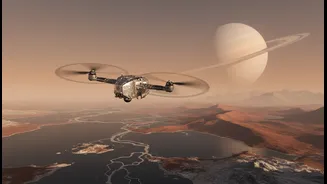
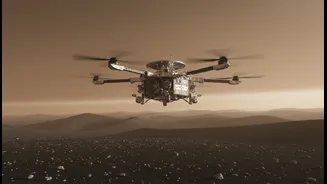
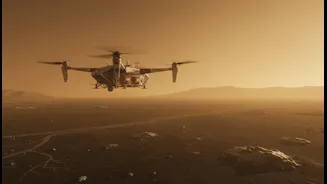
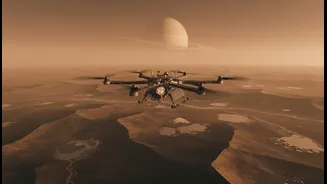
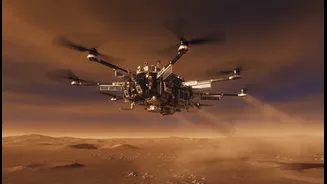
Scheduled to launch in July 2028, Dragonfly is a dual-quadcopter, or octocopter, destined for Saturn’s largest moon, Titan. After a long journey through the solar system, it is expected to arrive in 2034 to begin its unprecedented mission. Unlike the wheeled
rovers that have explored Mars, Dragonfly is designed to fly. Taking advantage of Titan’s thick atmosphere and low gravity, the nuclear-powered rotorcraft will be able to travel tens of kilometers in a single flight, hopping from one scientifically interesting location to another. This mobility is a game-changer for planetary exploration, allowing scientists to sample a wide variety of environments, from sand dunes to the floor of an impact crater, over its multi-year mission. It will be the first vehicle to fly its entire science payload across the surface of another world.
Titan: An Earth-like, Alien World
So, why Titan? This moon is one of the most intriguing bodies in our solar system. It is the only moon with a dense atmosphere, primarily composed of nitrogen like Earth's. It also boasts a weather system with clouds, rain, rivers, lakes, and seas. However, on Titan, the liquid is not water but methane and ethane. Beneath its frigid surface of water ice, scientists believe there is a vast ocean of liquid water. Most importantly, Titan's atmosphere is a rich factory for complex organic molecules. Sunlight and radiation break down nitrogen and methane, which then recombine to form the building blocks of life as we know it, raining down on the surface. This makes Titan a natural laboratory for studying prebiotic chemistry—the chemical steps that may have occurred on early Earth before life emerged.
The Search for Life's Ingredients
Dragonfly is not necessarily looking for life itself, but for the ingredients and conditions that could support it, a field known as astrobiology. The mission has three main scientific goals: to investigate how far prebiotic chemistry has progressed, to assess the moon's habitability, and to search for chemical biosignatures. To do this, Dragonfly is equipped with a sophisticated suite of instruments. A mass spectrometer (DraMS) will analyze the chemical makeup of surface samples to identify complex organic compounds like amino acids. A drill system (DrACO) will collect samples from beneath the surface, while a gamma-ray and neutron spectrometer (DraGNS) will determine the composition of the ground under the lander. Cameras and meteorological sensors will provide detailed views of the landscape and monitor the alien weather.
A Paradigm Shift in Exploration
Past planetary landers have been largely stationary, while rovers, though mobile, have been slow, covering only short distances over many years. The Mars helicopter Ingenuity proved powered flight was possible on another world, but it was a small technology demonstration with no science instruments. Dragonfly is a full-scale science laboratory on wings. Its ability to fly allows it to traverse distances that would take a rover decades to cover, if it could navigate the terrain at all. The mission plans to explore a landing site in the Shangri-La dune fields and eventually travel to the Selk crater, an area where scientists believe liquid water from an impact melt may have mixed with the abundant organic materials on the surface for thousands of years. Sampling such a location could provide groundbreaking insights into what happens when water and complex organics—two key ingredients for life—are combined.