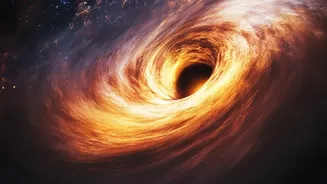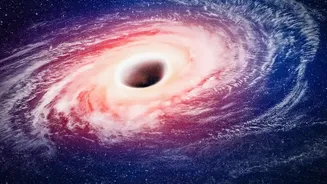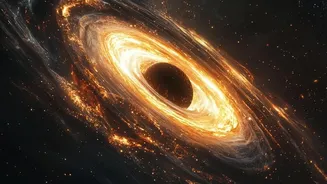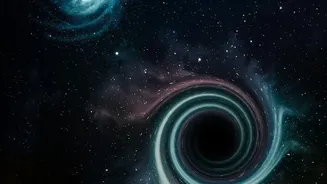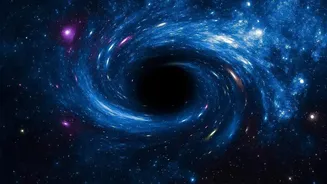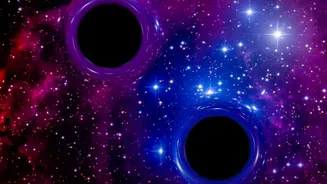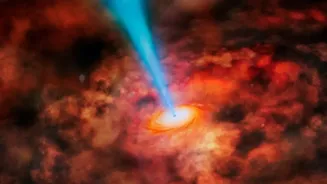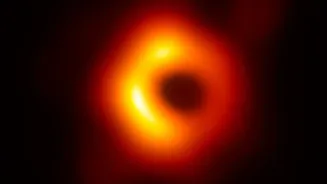




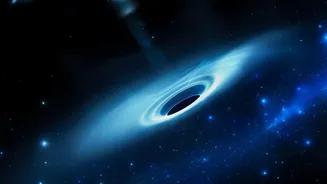
The universe is home to mind-bendingly massive objects, but few concepts stretch the imagination like a 'stupendously large black hole'. What are these cosmic titans, how would they form, and why are they still only a theory?
From Supermassive to Stupendously Large
Astronomers are familiar with
supermassive black holes (SMBHs), which have masses millions or even billions of times that of our sun. They reside at the heart of most large galaxies, including our own Milky Way, which hosts Sagittarius A* at a relatively modest 4 million solar masses. The largest confirmed black holes, sometimes called ultramassive, can reach tens of billions of solar masses, like the one powering the quasar TON 618, which weighs in at around 66 billion suns. Stupendously Large Black Holes, or SLABs, represent a theoretical class of object that dwarfs even these giants. The proposed mass range for a SLAB starts at 100 billion solar masses and could potentially reach a quintillion (a one followed by 18 zeros) times the mass of the sun. Such an object would not just dominate a galaxy; it could outweigh an entire galaxy cluster.
Two Paths to an Unseen Giant
How could such a monstrous object possibly form? Scientists propose two main pathways. The first involves the familiar process of accretion, where a black hole grows by consuming gas, dust, and stars, or by merging with other black holes. However, there are physical limits to how fast a black hole can grow this way. The intense radiation from the matter spiralling into the black hole can push away other potential fuel, throttling its growth. Current models suggest this process maxes out around 100 billion solar masses. The more exotic and, according to some theorists, more likely origin for SLABs is that they are 'primordial'. Primordial Black Holes (PBHs) are hypothetical objects that could have formed directly from immense density fluctuations in the hot, early universe, moments after the Big Bang, long before stars and galaxies existed. Because they weren't formed from collapsing stars, PBHs could theoretically span a vast range of masses, from tiny to stupendously large.
The Hunt for Hypothetical Behemoths
If SLABs exist, they are incredibly elusive. To date, no observational evidence has confirmed their existence. One reason is that they are expected to be extremely rare. Another is the challenge of detection. A SLAB that formed primordially might exist in the vast emptiness of intergalactic space, far from the bright galactic centers where we typically hunt for black holes. However, theorists have proposed clever ways to search for them. One method involves looking for their 'shadows'. A SLAB would be so large that it could cast a detectable shadow against the Cosmic Microwave Background (CMB), the faint afterglow of the Big Bang. This would appear as a 'negative source' or a cold spot in microwave data. Another potential signature relates to dark matter. A SLAB’s immense gravity would trap a dense halo of dark matter particles, which could lead to their annihilation and produce a unique glow of gamma rays.
Why Do These Ghosts Matter?
While SLABs remain purely theoretical, the search for them has profound implications. Proving their existence would revolutionize our understanding of the early universe. If they are found to be primordial, it would lend strong support to theories about the conditions right after the Big Bang and could even offer clues about the nature of dark matter. Even if they don't exist, figuring out why they don't can be just as valuable. The constraints placed on their possible numbers and sizes help scientists refine models of cosmology. For instance, recent studies analyzing the CMB have already been able to rule out the idea that SLABs could make up a significant portion of the universe's missing dark matter. The analysis showed that if they were a major component, the CMB would appear 'grainy' in a way that does not match observations.