



A Solar System in Miniature
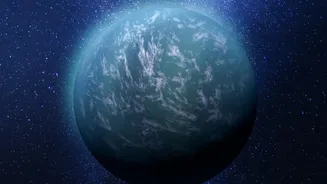
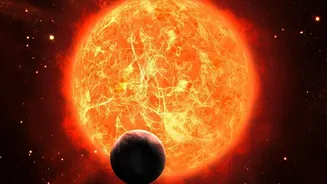
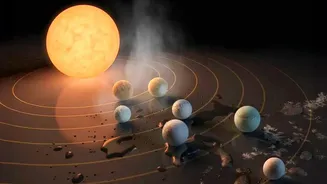
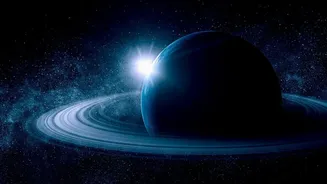
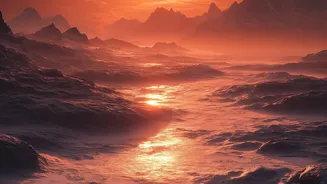
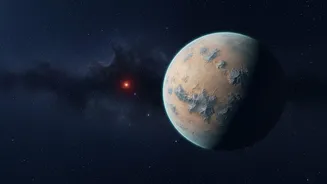
The TRAPPIST-1 system is one of the most exciting discoveries in modern astronomy. It's a collection of seven rocky planets, all similar in size to Earth or Venus, orbiting a small, cool red dwarf star. At least three of these planets orbit within the star’s
‘habitable zone’—the temperate region where surface temperatures could potentially allow for liquid water. This makes the system a prime laboratory for studying planetary formation and the potential for life beyond our solar system. However, there's a major catch. Red dwarf stars like TRAPPIST-1 are notoriously volatile, especially in their youth. They can blast their nearby planets with intense radiation and stellar winds capable of stripping away their atmospheres over billions of years. The crucial question, then, is not just whether these planets formed with water, but whether they managed to keep it.
Reading an Atmosphere from Light-Years Away
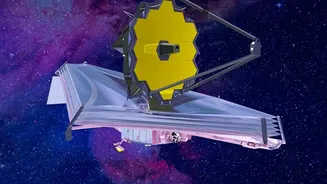
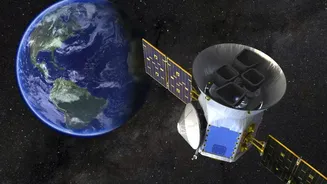
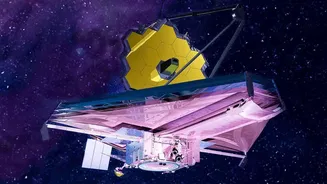
Astronomers can’t visit these worlds, so they rely on clever detective work using tools like the James Webb Space Telescope (JWST). The primary method is called transmission spectroscopy. When a planet passes in front of its star from our point of view, a tiny fraction of the starlight filters through its atmosphere. Different gases and elements in that atmosphere absorb specific colours, or wavelengths, of light. By analysing the starlight that reaches us, scientists can identify the chemical fingerprints of molecules like carbon dioxide, methane, and water vapour. Recent JWST observations have already delivered sobering news for the two innermost planets, TRAPPIST-1b and TRAPPIST-1c, suggesting they have very thin atmospheres, if any at all, and are likely not Venus-like worlds with thick carbon dioxide clouds.
The Atomic Fingerprint of a Lost Atmosphere
This is where 'heavy carbon' comes in. Most carbon atoms in the universe are Carbon-12, with six protons and six neutrons. However, a small fraction is Carbon-13, which has an extra neutron, making it slightly heavier. This tiny difference in mass is critical. When a planet’s atmosphere is being eroded by stellar radiation, the lighter atoms and molecules escape into space more easily than their heavier counterparts. This process, known as atmospheric escape, is like a slow leak that preferentially vents the lightest particles. Over billions of years, an atmosphere that has suffered significant loss will become noticeably enriched with heavier isotopes like Carbon-13. By measuring the ratio of Carbon-13 to Carbon-12, astronomers can essentially perform planetary forensics, estimating how much of the original atmosphere has vanished.
Connecting Carbon to Water
The link between carbon isotopes and water retention is indirect but powerful. For a rocky planet to have liquid water on its surface, it needs an atmosphere thick enough to provide sufficient pressure and a moderate greenhouse effect to keep it from freezing or boiling away. If observations reveal a high ratio of heavy to light carbon, it’s a strong indicator that the planet has lost a massive amount of its atmosphere over its lifetime. This atmospheric stripping wouldn’t just remove carbon; it would also carry away other crucial elements, including the components of water. Any water vapour would be broken down by radiation, and the light hydrogen would be the first thing to escape, followed by the rest of the thinning atmosphere. A history of dramatic atmospheric loss makes it highly improbable that a planet could have maintained a stable environment for surface water. In short, the carbon ratio serves as a proxy for a planet’s entire atmospheric history and, by extension, its ability to remain a water world.
The Search for Answers at TRAPPIST-1
While the principle is sound, applying it to Earth-sized planets 40 light-years away pushes the limits of our current technology. The initial JWST findings that the inner TRAPPIST-1 planets are likely bare rock align with the theory that their proximity to the star caused them to lose their atmospheres and water long ago. The focus is now shifting to the outer planets in the habitable zone, like TRAPPIST-1e, f, and g. These worlds are farther from the star and have a better chance of having held onto their atmospheres. Future observations will search for the telltale signatures of carbon and its isotopes. Finding a 'normal' carbon ratio would be an encouraging sign, suggesting a stable atmosphere. Conversely, detecting a high proportion of heavy carbon would imply that even these more promising worlds may have had their potential for life stripped away, one atom at a time.