




An Unbroken Sacred Tradition
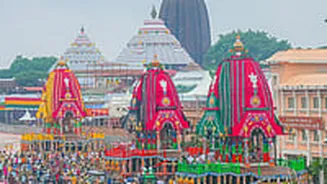
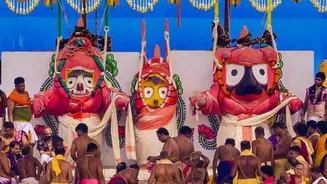
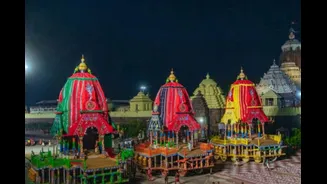
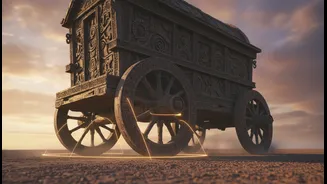
The construction of the three chariots—Nandighosha for Lord Jagannath, Taladhwaja for Lord Balabhadra, and Darpadalana for Devi Subhadra—is a tradition steeped in centuries of history and religious doctrine. These are not just vehicles; they are considered
living, sacred entities. The rules for their creation are not written in modern manuals but are passed down through generations of craftspeople. This hereditary knowledge ensures that every aspect of the chariot, from its dimensions to the materials used, adheres to ancient customs that have remained unchanged for centuries. The entire process begins on the auspicious day of Akshaya Tritiya and is seen as a form of devotional service, or 'seva'.
The Art of Wood-Only Joinery
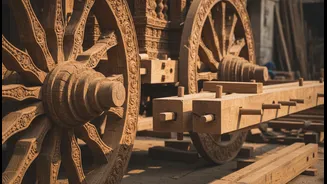
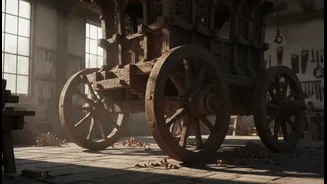
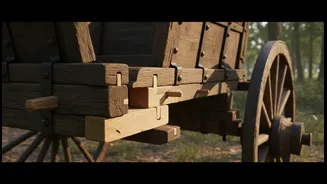
Instead of metal nails, the skilled artisans, known as 'Viswakarma sevayats' or 'Maharanas', employ a sophisticated system of interlocking wooden joinery. This technique involves creating strong joints, dowels, and pegs carved from the wood itself to hold the massive structures together. The process, locally known as 'salabendha', is a testament to ancient Indian engineering. Despite carrying immense weight and being pulled by thousands of devotees through crowded streets, these chariots remain remarkably stable. This method requires incredible precision and a deep understanding of carpentry, as the craftsmen work without modern measuring tapes, relying instead on traditional units like the 'haat' (hand span).
Symbolism of Purity and Impermanence
The primary reason for avoiding iron is rooted in spiritual belief. Following age-old temple traditions, the use of metal nails is shunned to maintain the organic purity and sanctity of the chariots. The construction relies on specific sacred woods like Phasi, Dhaura, and Asana, which are carefully selected from designated forests. The use of all-natural materials reinforces the idea that the chariots are living extensions of the divine. Furthermore, the chariots are built anew every single year. After the festival, they are ceremonially dismantled, and the wood is sent to the temple kitchen to be used as firewood for cooking the 'mahaprasad'. This practice symbolizes the Hindu concept of life's cyclical nature—a constant process of creation, service, and renewal.
The Divine Craftsmen
The knowledge of this unique construction is the exclusive domain of a few families in and around Puri who have been performing this duty for generations. The work is divided among different specialized groups. The 'Badhei Maharanas' handle the main construction, 'Pahi Maharanas' fix the wheels, and 'Ojha Maharanas' (blacksmiths) historically prepared any necessary iron clamps for axles, though not for the structural body. Painters ('Chitrakaras'), sculptors ('Rupakaras'), and tailors ('Daraji Sevakas') also play crucial roles in decorating the magnificent structures. This hereditary system ensures that the intricate techniques are preserved and passed down, safeguarding the authenticity of the Rath Yatra for future generations.