


First, Let’s Redefine 'Day' and 'Year'
On Earth, our concepts of time are straightforward. A ‘day’ is the time it takes for our planet to complete one full rotation on its axis, giving us the cycle of day and night. That's about 24 hours. A ‘year’ is the time it takes for Earth to complete one full orbit
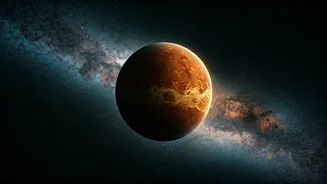
around the Sun, roughly 365.25 days. These two motions—spin and orbit—are fundamental to how we measure time. However, when we look at other planets, we find that these fundamental rhythms can be wildly different. No planet demonstrates this better than Venus, our so-called 'twin' planet, which operates on a time scale that defies our earthly intuition.
The Venusian Year: A Quick Trip
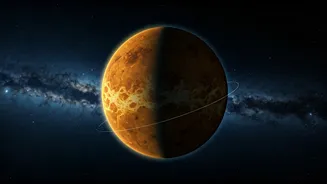
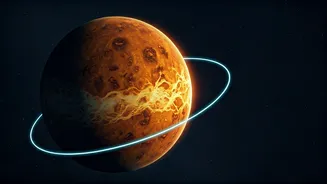
Let’s start with the easy part: the Venusian year. Venus is the second planet from the Sun, meaning its orbit is smaller and faster than Earth's. It zips around the Sun in just under 225 Earth days. So, if you were to celebrate your birthday on Venus, you'd be having a party every 225 days. This part is simple enough. A year on Venus is shorter than a year on Earth because it has less distance to travel in its solar orbit. Things get strange, however, when we look at the Venusian day.
The Venusian Day: An Incredibly Slow Spin
Here's where the headline's paradox comes into play. A planet's day is determined by its rotational speed. Earth spins at a brisk 1,670 kilometres per hour at the equator. Venus, on the other hand, is astronomically lazy. It rotates so slowly that it takes a staggering 243 Earth days to complete just one full spin on its axis. This single rotation is what astronomers call a sidereal day. When you compare the two figures, the bizarre truth becomes clear: a Venusian year (225 Earth days) is shorter than a single Venusian sidereal day (243 Earth days). The planet literally completes its journey around the Sun before it has even finished spinning once.
A Bizarre Twist: It Spins Backwards
As if a day longer than a year wasn't strange enough, Venus adds another layer of weirdness: it spins backwards. This is known as retrograde rotation. Almost every other planet in our solar system, including Earth, spins counter-clockwise on its axis (prograde motion). Venus, however, spins clockwise. This means if you could stand on the surface of Venus (which you can't, due to its crushing pressure and scorching 465°C temperature), you would see the Sun rise in the west and set in the east. This retrograde motion also has a curious effect on the length of the day-night cycle, which scientists call a 'solar day'.
The Solar Day Paradox
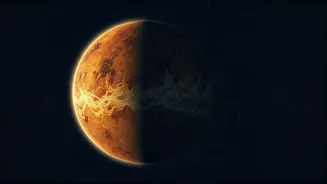
While a single rotation (sidereal day) takes 243 Earth days, the time from one sunrise to the next (solar day) is much shorter. Because the planet is rotating backwards while it orbits the Sun, the two motions work against each other in a way that shortens the perceived day-night cycle. The result is a solar day on Venus that lasts about 117 Earth days. So, while a full spin takes 243 days, you'd only have to wait about 117 days for the Sun to return to the same spot in the sky. This is still incredibly long by our standards, meaning you'd experience nearly two months of daylight followed by two months of darkness. It's a disorienting cosmic dance unlike anything we experience on Earth.
Why Is Venus So Strange?
Scientists are still debating why Venus has such a peculiar rotation. One leading theory suggests that Venus was struck by a massive asteroid or planetesimal early in its history. Such a cataclysmic impact could have been powerful enough to not only slow its rotation to a near-standstill but also reverse its direction entirely. Another theory involves the planet's incredibly thick, heavy atmosphere. Over billions of years, strong atmospheric tides could have created enough friction with the solid surface to gradually slow its spin. It's also possible that a combination of a powerful impact and long-term solar and atmospheric tidal forces worked together to create the bizarre planetary clock we see today.