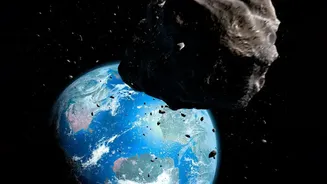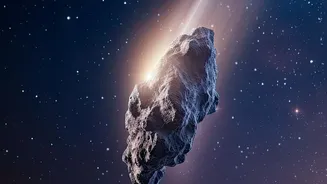




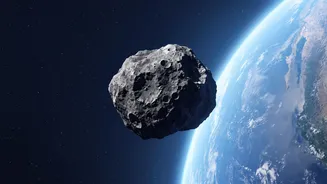

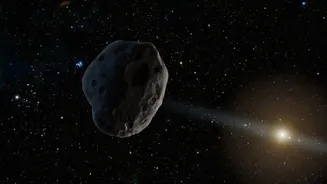
For the next few weeks, our planet has a second moon. It’s tiny, temporary, and you’ve probably never heard of it. Called 2026 QQ8, this small asteroid is a 'mini-moon' whose brief visit is a fascinating glimpse into our solar system's dynamics.
Meet Our Fleeting Companion
Earth
has a new, albeit temporary, natural satellite. Officially designated 2026 QQ8, this small asteroid was captured by our planet's gravity back in April 2026. However, it wasn't until August that Hungarian astronomer Krisztián Sárneczky, a seasoned asteroid hunter, first spotted the object. Initially, astronomers weren't sure what they were looking at. The object was so small and faint that it took several weeks of follow-up observations to confirm it was a natural asteroid and not a piece of old space junk. By late October, the International Astronomical Union's Minor Planet Center made it official, giving the celestial visitor its formal name. Unlike our permanent Moon, 2026 QQ8 is only about one to two metres across, roughly the size of a large appliance. Its visit is short-lived; it's expected to break free from Earth's gravitational pull in early December 2026 or January 2027 and resume its own orbit around the Sun.
What Exactly Is a Mini-Moon?
The term 'mini-moon' isn't an official astronomical classification, but it's a useful nickname for asteroids that are temporarily captured by a planet's gravity. This happens through a delicate cosmic dance. For an object to be captured, it needs to enter a planet’s 'Hill sphere'—the region where the planet's gravitational pull is stronger than the Sun's. Earth's Hill sphere extends out to about 1.5 million kilometres. The asteroid must also be moving slowly enough relative to Earth to fall into a temporary orbit instead of just flying by. The orbit of 2026 QQ8 is chaotic and looping, not the stable, nearly circular path of our main Moon. These captures are more common than one might think; some astronomers believe Earth may have one or more mini-moons at any given time, but most are too small and faint to detect.
A Farewell Tour of the Cosmos
So why is 2026 QQ8 leaving so soon? Temporary captures are, by their nature, unstable. The same gravitational forces from the Sun and other planets that can nudge an asteroid into our orbit can just as easily pull it back out. The asteroid's current trajectory is a complex, wobbly path that is only briefly bound to Earth. Projections show it will escape our gravitational influence in early December, though some models suggest it could hang on until January 2027. After it departs, 2026 QQ8 will continue on its own 359-day journey around the Sun, an orbit very similar to Earth's. This proximity means it has close encounters with our planet roughly every decade, but the precise alignment needed for another capture is rare. Its next notable pass won't happen until 2058, and it is not expected to be captured again at that time.
Can You See It?
Unfortunately, you won't be able to spot 2026 QQ8 with binoculars or a backyard telescope. The asteroid is incredibly small and faint. At its closest approach, it will be about 568,000 kilometres away, which is roughly one and a half times farther than our permanent Moon. Only large, professional-grade telescopes paired with sensitive cameras can detect it. While it's a tantalizing target for professional astronomers and dedicated astrophotographers, it will remain invisible to the rest of us. There's also no cause for alarm; the asteroid poses zero threat to Earth. Even if its path were to intersect with our planet, a rock this small would burn up completely in the atmosphere, likely creating nothing more than a bright meteor.