







The Limits of Traditional Models
For decades, scientists have relied on powerful, physics-based computer models to simulate the Earth's climate. These models are essential, but they are also incredibly complex and computationally expensive, often requiring massive supercomputers to run.
This limits the number of simulations that can be performed, making it hard to explore the full range of possible climate futures. Furthermore, these models can struggle to represent smaller-scale phenomena like cloud formation or local weather events with perfect accuracy, which can have significant knock-on effects for long-term projections. The sheer volume of data from modern observation systems also presents a challenge, as conventional methods can't always process it fast enough to provide real-time insights.
How AI Is Changing the Game
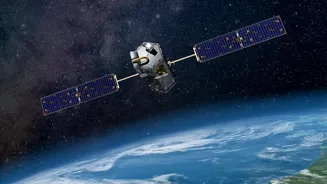
Artificial intelligence, particularly machine learning, excels at finding patterns in vast datasets. Instead of being programmed with the laws of physics, AI models learn directly from observational data, identifying intricate relationships that humans might miss. This allows them to process information from satellites, weather stations, and ocean sensors at incredible speeds. For example, AI algorithms can sift through satellite imagery to track deforestation, identify methane leaks from pipelines, or monitor melting ice sheets in near real-time. This ability to quickly analyse and interpret massive amounts of environmental data is transforming researchers' ability to monitor the planet's health.
Smarter Tools for Better Predictions
The latest wave of AI, including generative models similar to those behind tools like DALL-E, is pushing the boundaries even further. Researchers are now developing AI-powered climate emulators that can run simulations thousands of times faster than traditional models. For instance, one model called Spherical DYffusion can project 100 years of climate patterns in just 25 hours, a task that would take older models weeks. In India, AI-based forecasting systems are already providing farmers with monsoon predictions up to four weeks in advance, helping them make critical decisions about planting. These tools are also being used to generate hyper-local forecasts and create 'digital similars' of cities to test their resilience against floods or heatwaves.
The Challenge of Trust and Transparency
Despite its potential, the use of AI in climate science is not without challenges. One of the biggest concerns is the 'black box' problem—deep learning models can be so complex that even their creators don't fully understand how they arrive at a specific prediction. This lack of interpretability can make it difficult to trust AI-driven forecasts, especially when making high-stakes policy decisions. Researchers are actively working on 'explainable AI' (XAI) to make these models more transparent. There are also concerns about biases in training data; if data is sparse in certain regions, AI predictions for those areas may be less reliable. Furthermore, the massive data centres required to train and run these powerful AI models consume significant amounts of energy and water, creating its own environmental footprint that must be managed.