





The Universe’s Great Unseen
First, let's appreciate the scale of the problem. When astronomers observe galaxies, they see that stars on the outer edges are rotating far too quickly. Based on the visible matter, these galaxies should be flying apart. Something invisible, with immense
gravitational force, is holding them together. This invisible 'cosmic glue' makes up the majority of matter in the universe, yet it doesn't emit, reflect, or interact with light in any way we can detect. This substance is what physicists have termed dark matter. The Standard Model of particle physics, our best description of the fundamental particles and forces, has no candidate for what this particle could be. This glaring omission signals that new physics is needed to explain one of the cosmos' biggest puzzles.
Thinking Beyond Four Dimensions
When faced with a problem that current physics can't solve, some scientists look to truly radical ideas: what if our universe has more dimensions than we can perceive? The concept isn't new. In the 1920s, Theodor Kaluza and Oskar Klein proposed a fifth dimension to unify gravity and electromagnetism. Their idea was that this extra dimension could be curled up, or 'compactified', to an incredibly small size, which is why we don't experience it. Imagine an ant on a tightrope. From far away, the rope looks like a one-dimensional line. But for the ant, it has a second dimension: the circumference it can walk around. Modern theories, like string theory, also require extra dimensions to be mathematically consistent. These frameworks open the door to explaining phenomena that seem impossible in our four-dimensional (three space, one time) world.
Warped Reality and Hidden Particles
One of the most compelling extra-dimensional ideas is the 'warped geometry' or Randall-Sundrum (RS) model. Proposed in 1999, it suggests our four-dimensional universe is a 'brane' (like a membrane) existing within a five-dimensional bulk space that is curved, or warped. This warping has profound consequences. While most particles and forces of the Standard Model are stuck on our brane, gravity is not. It can travel through the bulk, which could explain why it seems so much weaker than other fundamental forces like electromagnetism. More importantly for the dark matter mystery, this model allows for new types of particles. Recent theories propose that certain particles, like fermions, could be pushed through portals into this warped fifth dimension. There, they would exist as 'dark sector' relics, interacting with our world primarily through gravity, making them perfect candidates for dark matter.
The Crucial Role of Calculation
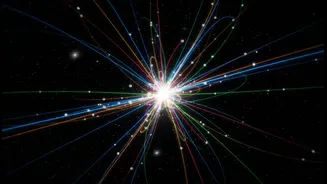
This is where particle-physics calculations become the critical testing ground for these theories. A theory is only as good as its predictions. These extra-dimensional models predict the existence of new, heavy particles, often called Kaluza-Klein (KK) particles, which are essentially heavier versions of familiar particles that get their mass from moving in the extra dimension. Specifically, theories point to KK gravitons—heavy relatives of the particle thought to carry the gravitational force—or other new fermions as the potential dark matter particle. Physicists use complex calculations to determine the expected mass of these particles and how they would interact. These calculations tell experimentalists at places like the Large Hadron Collider (LHC) what to look for. For example, a collision might produce a shower of familiar particles in one direction, with missing energy in the other, suggesting an invisible particle—perhaps a KK graviton—escaped into the fifth dimension.
The Search and Its Future
So far, experiments at the LHC have not definitively found evidence of these extra-dimensional particles. However, the search is far from over. Particle physics calculations are constantly refining the parameters, narrowing down the search area and ruling out certain versions of the models. For example, some calculations show that if dark matter is a scalar particle (a particle with no spin) in this framework, it should have been detected by now, essentially ruling out that specific scenario. However, models with fermion or vector dark matter candidates remain viable within specific mass ranges. A recent theory from July 2026 suggests the geometry of the fifth dimension might naturally cause a 'resonance', explaining why dark matter interacted strongly in the early universe but is so elusive today. This provides new targets and fresh hope for detection.