




A New Eye on the Cosmos
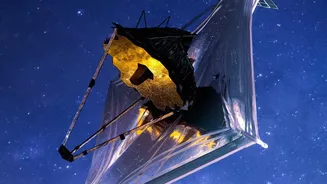
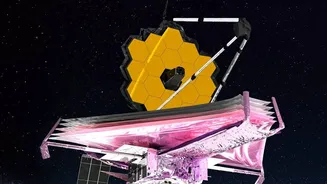
First, a quick refresher on why the Roman Telescope is such a big deal. Named after Nancy Grace Roman, NASA’s first chief of astronomy, this observatory is considered the next great space telescope, following in the footsteps of Hubble and the James Webb
Space Telescope (JWST). While its primary mirror is the same size as Hubble's, Roman’s key advantage is its incredible field of view. Its Wide Field Instrument can capture a patch of the sky at least 100 times larger than Hubble can in a single snapshot. This means Roman can create vast, panoramic maps of the universe with the same level of detail as Hubble but in a fraction of the time. Its primary goals are ambitious: to solve the mystery of dark energy, the force causing the universe's expansion to speed up, and to conduct a massive census of exoplanets—planets orbiting other stars.
The Race to Uncover Dark Energy
Roughly 68% of the universe is thought to be made of dark energy, but scientists still know very little about its true nature. Roman will tackle this enigma by mapping the universe's structure over billions of years. It will survey over a billion galaxies and detect thousands of Type Ia supernovae, which are stellar explosions that act as cosmic mile markers. By precisely measuring how these objects are distributed and how fast they are moving away from us, astronomers can trace the expansion history of the universe. This data will help them understand how dark energy’s influence has changed over cosmic time, offering crucial clues to what it is and what it means for the ultimate fate of the cosmos. An earlier start means this fundamental data will begin flowing to scientists sooner, potentially accelerating one of the most important quests in modern physics.
A Galactic Planet Census
Perhaps Roman's most exciting task for the public is its hunt for new worlds. The telescope is expected to discover thousands of exoplanets, potentially adding up to 100,000 new candidates to the thousands we already know. It will do this primarily using a technique called gravitational microlensing. This method detects planets by observing how their gravity, and that of their host star, bends and magnifies the light from a more distant background star. Microlensing is particularly good at finding planets that are farther from their star, in orbits similar to those in our own solar system, as well as rogue planets that roam the galaxy without a host star. Getting a head start on this survey will give us a much richer, more complete picture of planetary systems across our galaxy, helping us understand how common Earth-like worlds might be.
The Upside of an Early Start
Launching a flagship mission ahead of schedule is a testament to the meticulous planning and execution by NASA and its partners. The most obvious benefit is getting more science done, sooner. An earlier launch extends the potential operational lifetime of the telescope. Roman has a primary mission of five years, but space telescopes often last much longer. Starting early could mean an extra year or more of observations, translating to a greater scientific return on a multi-billion dollar investment. This could allow for deeper surveys, more follow-up observations of interesting targets discovered by Roman or other telescopes like JWST, and a greater chance of making entirely unexpected discoveries. It also means the vast amounts of data—expected to be around 1.4 terabytes per day—will be available to researchers worldwide much sooner.
Potential Risks and Trade-Offs
While an early launch is overwhelmingly positive, accelerating any major space mission is not without potential trade-offs. Typically, mission schedules have buffers built in for extensive testing and troubleshooting. Rushing a launch could, in theory, increase the risk of an unforeseen issue emerging once the spacecraft is in orbit, where it is impossible to service. For an uncrewed observatory like Roman, every system must work perfectly right out of the box. However, NASA's announcement of the accelerated timeline suggests that all pre-flight checks and preparations were completed ahead of schedule, meeting the agency's rigorous safety and performance standards. While it's unlikely any corners were cut, mission planners will have carefully weighed the immense scientific benefits of an early start against any residual risks, however small.