





A Landmark Date with Pluto
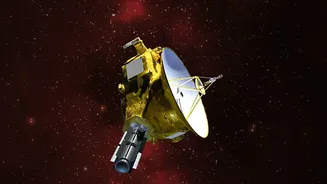
The New Horizons mission, launched in 2006, was a nine-and-a-half-year journey to the edge of our solar system. Its primary objective was to conduct the first-ever flyby of Pluto. The data it collected transformed our understanding of the dwarf planet,
revealing a complex world with vast nitrogen-ice glaciers, towering mountains of water ice, and a surprisingly thin blue atmosphere. It sent back images and information that were 5,000 times more detailed than anything before it, finally giving humanity a close look at this distant, icy body and its moons. For many, this monumental achievement was the culmination of the mission, the grand finale of a decades-long dream. However, for the mission's planners, it was just the beginning of a new chapter.
An Encore in the Kuiper Belt
After its Pluto encounter, the healthy and capable New Horizons spacecraft was directed toward a new target deep in the Kuiper Belt, a vast ring of icy bodies beyond Neptune. On January 1, 2019, it successfully flew past Arrokoth, the most distant object ever explored by a spacecraft. Arrokoth, a contact binary that resembles two flattened lobes stuck together, is a primordial object, a relic from the formation of the solar system some 4.5 billion years ago. Studying it provided an unprecedented look at a planetary building block, preserved in the cold, dark reaches of space. This flyby, a billion miles beyond Pluto, wasn't part of the original plan but became possible because the spacecraft was still operating perfectly.
The Strategic Value of an Extended Mission
The journey to Arrokoth is a prime example of the value of an extended mission. The most expensive and difficult part of any deep space mission is designing, building, testing, and launching the spacecraft. Once it’s in space and has completed its main goal, the hardware is already there. For a fraction of the initial investment, NASA can continue to operate the probe, gathering bonus science that would otherwise be impossible. These extended missions maximize the scientific return on the taxpayer's investment. With a healthy spacecraft and a skilled team, new targets of opportunity can be identified, and new scientific questions can be answered. It turns a single-purpose mission into a long-term exploratory platform.
A Tradition of Discovery
New Horizons follows a proud tradition of long-lived NASA missions. The Voyager 1 and 2 probes, launched in 1977 to study Jupiter and Saturn, are still operating more than 45 years later, having explored Uranus and Neptune and are now sending back data from interstellar space. The Cassini spacecraft, after completing its primary four-year tour of Saturn, went on to operate for another nine years in two extended missions, the 'Equinox' and 'Solstice' missions, allowing scientists to observe a full seasonal period on the ringed planet for the first time before its grand finale in 2017. These missions demonstrate that longevity and adaptability are key to unlocking some of the solar system's greatest secrets.
The Long Journey Outward
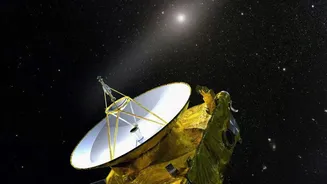
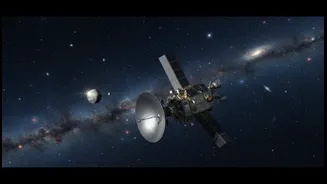
As of mid-2026, New Horizons is still journeying through the outer Kuiper Belt, nearly 6 billion miles from Earth. After waking from a period of hibernation to conserve power, the spacecraft continues to function as a unique observatory in a region no other active mission is exploring. Its instruments measure the charged particles of the solar wind and the dust environment at the fringes of the solar system, providing crucial data on the boundary between our sun's influence and interstellar space. The mission team has plans to continue operations until it exits the Kuiper belt around 2028 or 2029, and potentially even identify another distant object for a flyby. The spacecraft is expected to have enough power to continue operating into the 2050s, continuing its slow, silent journey out of the solar system.