


A Tale of Two Poles
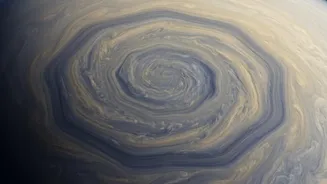
For decades, one of Saturn’s most captivating features has been the bizarre, six-sided jet stream encircling its north pole. First spotted by the Voyager probes in the 1980s, the northern hexagon is a remarkably stable weather pattern, a fixture of the planet's
atmosphere for over 40 years. Astronomers had long searched for a similar structure at the south pole, but missions like NASA's Cassini, which orbited the planet from 2004 to 2017, found no such long-lived formation. This made the north pole's hexagon seem like a one-of-a-kind wonder. That is, until now. Thanks to the keen eye of the Hubble Space Telescope, scientists are watching a brand new, and distinctly different, geometric shape take form at the opposite end of the planet.
Discovery of a Southern Decagon
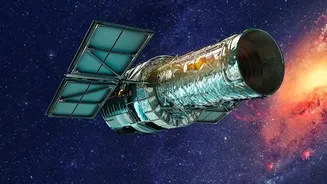
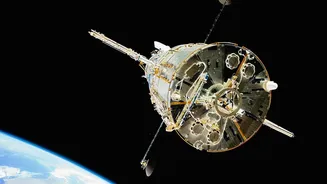
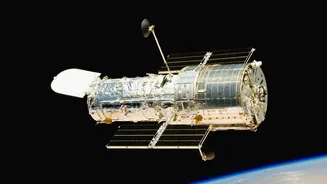
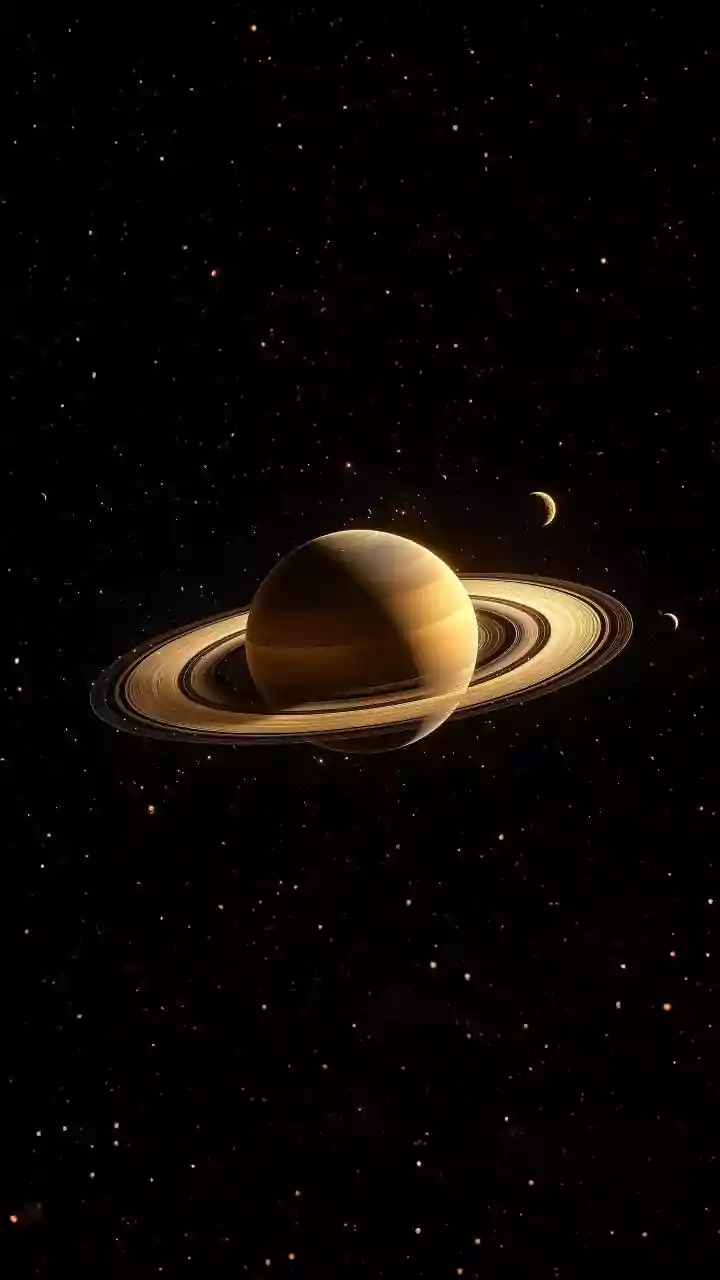
Recent observations have revealed a giant, evolving 10-sided atmospheric wave, or decagon, wrapping around Saturn's south pole. This is the first time a large, regular-sided jet pattern has been observed in the planet's southern hemisphere. The discovery was made possible by a combination of factors. As Saturn's long seasons changed, its south pole, which was hidden from Earth's view for years, tilted back into sight. In 2024, keen-eyed amateur astronomers noticed a faint, wavy band in ground-based images, providing the first hint. This prompted researchers to use the powerful Hubble Space Telescope, which confirmed the feature's presence and was able to trace its initial formation back to archival images from 2023.
Hubble's Unblinking Eye
The continuous tracking of this new wave is a testament to Hubble's Outer Planet Atmospheres Legacy (OPAL) program. Started over a decade ago, OPAL is designed to capture annual, high-resolution images of our solar system's gas giants. This long-term monitoring allows scientists to study weather patterns, track storms, and observe seasonal changes that would otherwise be missed. For the Saturnian decagon, the OPAL data has been crucial. By reviewing images captured each year, astronomers can watch the feature strengthen and evolve in near real-time. According to Amy Simon, the OPAL program's principal investigator, this gives scientists the rare opportunity to watch a giant atmospheric pattern develop from its early stages.
What Makes It So Unusual?
While similar to the northern hexagon in concept, the southern decagon is unique. It appears to have formed very recently and is still evolving, unlike the stable, decades-old hexagon. Hubble's observations across different wavelengths of light show that this is not just a surface-level cloud pattern. The wave extends deep into multiple layers of Saturn's atmosphere, indicating it is a significant, vertically-structured phenomenon. This depth is revealed because different light filters probe different altitudes, causing the decagon's apparent position to shift slightly in various images. Its formation now raises a key question for scientists: Why here, and why now?.
The Search for an Explanation
Scientists are now working to understand what is driving this colossal wave. One theory is that a powerful storm, an upwelling from deep within Saturn's turbulent atmosphere, may have disrupted the high-speed jet stream and triggered the 10-sided pattern. Another possibility involves what are known as Rossby waves, which form in rotating fluids and can be bent into geometric shapes by variations in latitude, similar to how jet streams behave on Earth. The northern hexagon is believed to be a type of Rossby wave, and this new decagon could be a different manifestation of the same physics. To test these ideas, researchers are using computer models and planning further observations with both Hubble and the James Webb Space Telescope to unravel the mystery.