





The Cosmic Data Deluge
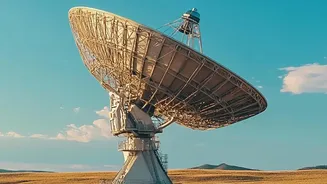
Modern astronomy is facing a torrent of information. Telescopes like the Vera C. Rubin Observatory in Chile, which began operations in 2025, are designed to capture the entire southern sky every few nights. This facility alone is expected to generate
up to 20 terabytes of data nightly, creating a 500-petabyte dataset over its ten-year mission. For context, that's like trying to watch millions of high-definition movies at once to find a single, fleeting scene. Traditional methods, which often rely on astronomers manually inspecting images and data, are simply no match for this scale. It's a classic needle-in-a-haystack problem, except the haystack is the size of the cosmos and it's growing at an impossible rate. Without a new approach, countless discoveries could remain buried in the noise.
An Artificially Intelligent Assistant
This is where artificial intelligence, specifically machine learning, steps in. AI algorithms can be trained to do what the human brain does, but on a massive scale: recognize patterns. By feeding an AI model millions of labeled examples—this is a star, this is a galaxy, this is an imaging flaw—it learns to classify new objects with incredible speed and accuracy. These systems, often called neural networks, can sift through terabytes of fresh data in near real-time, flagging anything that moves, changes brightness, or simply looks out of place. It acts as a tireless assistant, automating the tedious work of data sifting and allowing human astronomers to focus their expertise on the most promising and unusual candidates the AI finds.
A Planetary Defense System
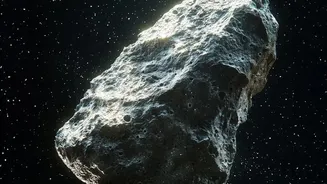
One of the most critical applications for this technology is planetary defense. Thousands of near-Earth objects (NEOs), such as asteroids and comets, orbit the sun, and some have paths that could bring them dangerously close to our planet. Manually finding these relatively small, fast-moving objects in a sky filled with billions of stars is a monumental task. AI models can automate this process. For example, a project at the Catalina Sky Survey used an AI model called NEO AID (Near Earth Object Artificial Intelligence Detection) to improve its detection rate. The AI learns to distinguish the faint streak of a moving asteroid from a satellite flare or a cosmic ray hitting the detector. This allows for faster identification and tracking, giving humanity more time to act if a threatening object is found.
Finding Worlds Beyond Our Own
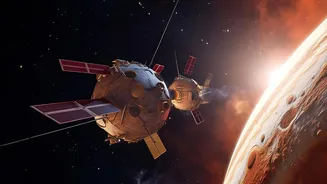
AI is also revolutionizing the search for exoplanets, which are planets orbiting other stars. One of the most common detection methods involves looking for tiny, periodic dips in a star's light, caused by a planet transiting in front of it. These signals are incredibly faint and can easily be mistaken for stellar activity like starspots. In 2017, an AI developed by Google and NASA analyzed old data from the Kepler Space Telescope and discovered two new exoplanets, Kepler-90i and Kepler-80g, that had been missed by previous human analysis. More recently, NASA's ExoMiner software has used AI to validate hundreds of new exoplanets from Kepler and TESS mission data. AI not only finds planets but can also help characterize their atmospheres, bringing us a step closer to finding worlds with conditions suitable for life.
Discovering the Unknown Unknowns
Perhaps the most exciting prospect of AI in astronomy is its potential to find things we weren't even looking for. Supervised learning algorithms are trained on known phenomena, but unsupervised learning can spot anomalies and outliers that don't fit any existing category. Recently, an AI tool sifted through data from the Hubble Space Telescope and identified nearly 1,400 anomalous objects, over 800 of which had never been documented. Most were interacting galaxies or gravitational lenses, but dozens defied classification entirely. As new observatories like the Vera C. Rubin and Nancy Grace Roman Space Telescope come online, AI will be crucial for navigating their data and uncovering new cosmic mysteries, from the nature of dark matter to entirely new types of celestial phenomena.