



More Than Just a Boat
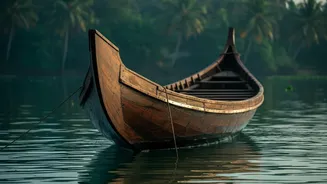
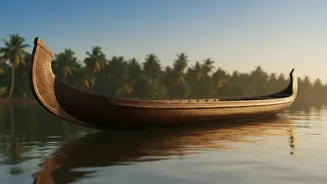
The Chundan Vallam is the soul of many Keralan villages, a symbol of pride and unity fiercely displayed during the Vallamkali (boat race) season. These races, held during festivals like Onam, are not merely sporting events but the culmination of a year-long
relationship between the community and its boat. Originating as war vessels for 14th-century kings, their construction follows ancient principles laid down in the 'Sthapathya Veda', a treatise on wooden boat building. Each boat belongs to a village, and the residents worship it as a deity, a living entity that embodies their collective spirit. This reverence dictates that only men, barefoot as a sign of respect, are permitted to touch the hallowed wood.
The Search for the Right Soul
The creation process starts in the forest. While the headline mentions teak, the most prized timber for a snake boat is Anjili (Artocarpus hirsutus), a type of wild jackfruit wood known for its flexibility and resistance to rot in water. A master craftsman, known as the 'Melsari' or 'Moothashari', leads the search. Selecting the right trees is a spiritual quest. The artisans look for tall, mature trees, often with specific curves that align with the boat's intended design. Before the first cut is made, a puja (worship ceremony) is performed to ask the forest deities for permission and to honour the spirit of the tree that will give its life to become the vessel. The process begins on a day deemed auspicious, ensuring the entire endeavour is blessed from the start.
The Master's Vision Takes Shape
There are no modern computer-aided designs or detailed blueprints in a traditional boatyard. The Melsari, a hereditary title for these master carpenters, holds the boat's design in his mind, passed down through generations. These artisans, from the Vishwakarma community, rely on an intuitive understanding of hydrodynamics and sacred geometry. Using a reference drawing called a 'Rekhachithram', often sketched on a wooden plank, the Melsari directs a team of carpenters. Measurements are precise, but born of experience rather than software. Even a slight deviation in the hull's curvature can compromise the boat's speed and stability, a critical factor in the highly competitive races.
From Log to Leviathan
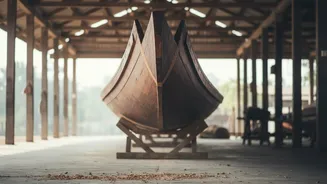
Once the massive logs arrive at the 'malipura' (crafting shed), the physical transformation begins. The construction is a community affair, with villagers participating in key stages. One of the first major rituals is 'Ulikuthu', where the head carpenter makes the first ceremonial cuts with a chisel, officially commencing the build. Planks as long as 80 feet are meticulously shaped and joined together. A crucial and dramatic moment is the 'Malarthi Karmam', the inversion of the massive, partially built hull. It requires the collective strength of the village men, who flip the structure to the rhythm of chants and songs. A special glue, often made from resin, cotton, and coconut oil, is used to seal the gaps, and the entire surface is later coated with a mixture of fish oil, ash, and egg whites to make it waterproof and slippery.
A Vessel Consecrated
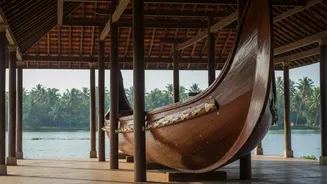
The boat is more than wood and nails; it is a divine vessel. The towering rear portion, the 'Amaram', which rises nearly 20 feet, is decorated with ornate carvings and brass elements. These include nine hollow hemispheres ('Kumilas') representing the nine planets (Navagraha) and another pair symbolising the sun and moon gods. The final and most joyous ceremony is the 'Neeraniyal Karmam', the boat's first launch into the water. It is a moment of immense celebration as the entire village gathers to watch their shared icon, their pride, finally embrace the backwaters it was born for. This ritual transforms the boat from an object into a sacred entity, ready to compete for the glory of its people.