





A Journey to the Center of a Planet
Deep beneath Earth's rocky crust and mantle lies a metallic core we can never directly see. But what if a similar core existed out in space, exposed and ready for exploration? That is the tantalizing possibility behind NASA's Psyche mission. Launched
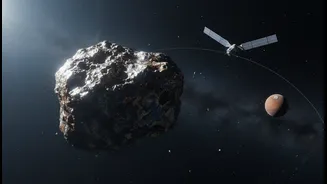
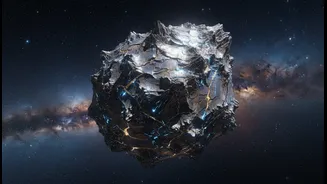
on October 13, 2023, the van-sized Psyche spacecraft is on a 3.6-billion-kilometre journey to the main asteroid belt between Mars and Jupiter. Its destination is 16 Psyche, an object approximately 280 kilometers across at its widest point that appears to be composed largely of metal. Scientists theorize that it could be the leftover nickel-iron core of a planetesimal—a building block of a planet—that was shattered by violent collisions during the chaotic formation of our solar system. By studying Psyche up close, we get a unique window into the hidden hearts of terrestrial planets like our own.
The Long Cruise to a Metal World
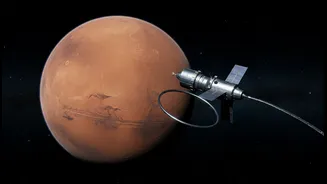
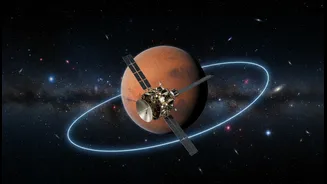
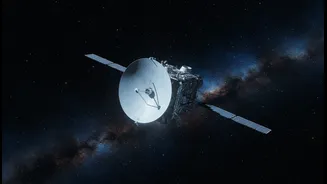
Reaching this unique destination is a monumental undertaking. The spacecraft is currently on a multi-year cruise, powered by highly efficient solar electric propulsion. This system uses large solar arrays to generate electricity that powers Hall-effect thrusters, which expel charged xenon ions to create gentle but constant thrust. In May 2026, the spacecraft performed a crucial flyby of Mars. This maneuver wasn't for sightseeing; it was a gravity assist, using Mars's gravitational pull to slingshot the spacecraft, increasing its speed and adjusting its trajectory toward the asteroid belt without using precious onboard fuel. After its Mars flyby, Psyche resumed its long journey. The spacecraft is scheduled to be captured by the asteroid's gravity in late July 2029, with its primary science mission beginning in August 2029.
The Scientific Toolkit
The Psyche spacecraft will not land on the asteroid but will orbit it for about two years, studying it from four different altitudes. To do this, it is equipped with a suite of advanced scientific instruments. A pair of multispectral imagers will capture high-resolution photos, allowing scientists to map the surface and distinguish between metallic and rocky materials. A Gamma-Ray and Neutron Spectrometer will determine the specific chemical elements that make up the surface. Meanwhile, a magnetometer will search for any evidence of a leftover magnetic field, which would be a strong indicator that Psyche was once the molten core of a larger planetary body. Finally, by analyzing the X-band radio signals from the spacecraft, scientists can precisely measure Psyche's gravity field, revealing clues about its internal structure.
Answering Fundamental Questions
The mission has several key science objectives. First and foremost, scientists want to determine if Psyche is truly a planetary core or if it's made of unmelted primordial material from the early solar system. The mission will also characterize the asteroid's topography, determine the relative ages of different surface regions, and explore whether it was formed under conditions similar to Earth's core. There are two main hypotheses about its origin: it could be the stripped core of a planetesimal, or it might be a different kind of iron-rich body that formed from metal-rich material that never fully melted. Data from radar observations suggest it's a mixture of rock and metal, with metal comprising 30% to 60% of its volume. Getting up close is the only way to solve these mysteries.
Pioneering Technology and Future Potential
Beyond its primary science goals, the Psyche mission is also a testbed for future technology. The mission is demonstrating the Deep Space Optical Communications (DSOC) system, which uses lasers to transmit data at a much higher rate than traditional radio waves. This technology could revolutionize how we communicate with spacecraft on future missions to Mars and beyond. While Psyche is a purely scientific mission, the data it gathers will be invaluable for the burgeoning field of asteroid mining. Understanding the composition of M-type asteroids like Psyche could inform future commercial ventures, though the practicalities of mining an object so far away mean it won't be happening anytime soon. For now, the focus is on the priceless scientific return.