



A New Eye on the Cosmos
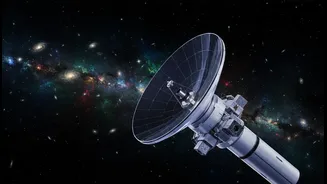
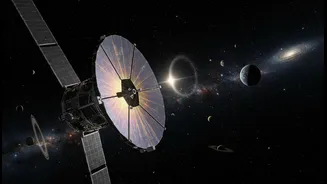
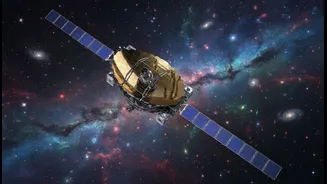
Scheduled for launch on August 30, 2026, the Nancy Grace Roman Space Telescope is NASA's next great observatory. While telescopes like Hubble and Webb excel at taking incredibly deep, narrow portraits of small patches of the sky, Roman is designed for breadth.
Its primary mission is to conduct vast surveys of the universe, creating enormous panoramic images with the same level of detail, or resolution, as Hubble. This shift in strategy—from focused stare to sweeping survey—is made possible by its groundbreaking primary instrument, the Wide Field Instrument (WFI). The goal is no longer just to study individual objects but to understand the entire cosmic ecosystem they inhabit.
The Power of a Wider View
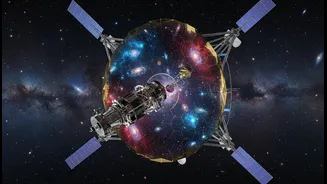
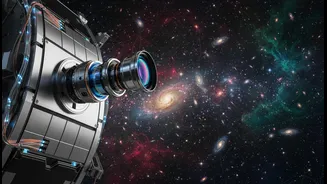
The heart of the Roman telescope is its Wide Field Instrument, a 300.8-megapixel camera that gives it a colossal field of view. In a single shot, Roman can capture an area of the sky 100 times larger than Hubble can with its infrared camera. To put that in perspective, while Hubble might need hundreds of individual images to create a mosaic of a neighboring galaxy like Andromeda, Roman could cover the same area in just two. This incredible efficiency is what allows Roman to survey the sky up to 1,000 times faster than Hubble. Instead of seeing a single tree in the cosmic forest, Roman will see the entire forest, allowing scientists to study how different parts of the universe are connected on the grandest scales.
From Pictures to Population Studies
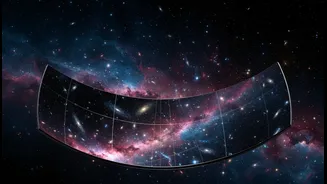
This wide-angle capability transforms astronomy from a hunt for curiosities into a powerful statistical science. Rather than just capturing beautiful images, Roman's primary job is to create a massive catalog of celestial objects. Its main survey will map over 5,000 square degrees of the sky, or about 12% of the total, charting the positions and properties of hundreds of millions, and potentially over a billion, galaxies. This creates a 'rich statistical map' that allows astronomers to analyze the universe's structure and evolution. It's like moving from studying individual people to conducting a full-scale census of a country. By analyzing these huge populations of galaxies and stars, scientists can measure cosmic properties with unprecedented precision and test fundamental theories about the universe's behavior.
Hunting for Cosmic Ghosts
Two of the biggest mysteries in modern physics are dark energy and dark matter, which together are thought to make up 95% of the universe. Roman is specifically designed to hunt for clues about these elusive components. It will do this in several ways, including by mapping the distribution of galaxies and using a phenomenon called weak gravitational lensing. Weak lensing is the subtle distortion of light from distant galaxies as it passes by massive clumps of dark matter. By statistically analyzing the distorted shapes of hundreds of millions of galaxies, Roman can create a detailed map of the invisible dark matter scaffolding of the cosmos. To study dark energy—the force accelerating the universe's expansion—Roman will also track thousands of distant exploding stars, or supernovae, using them as cosmic distance markers.
A Census of Distant Worlds
Beyond cosmology, Roman’s wide-field view makes it a prolific planet-hunting machine. It will conduct a massive survey of the dense star fields toward the center of our Milky Way galaxy, monitoring hundreds of millions of stars. Its primary method will be gravitational microlensing, a technique where a foreground star and its planet act as a natural lens, briefly magnifying the light of a more distant background star. This method is sensitive to planets that other techniques, like the transit method used by Kepler, often miss—including planets far from their star and even "rogue" planets that float freely through the galaxy without a parent star. This Galactic Bulge Time-Domain Survey is expected to discover thousands of new exoplanets, providing a statistical census of planetary systems throughout our galaxy.