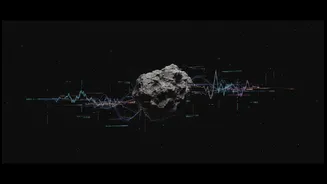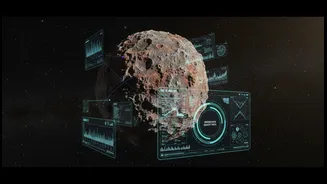









A Universe of Data at Your Fingertips
Space agencies like the European Space Agency (ESA) and NASA have championed a move towards open data, giving the public unprecedented access to the cosmos. Through online portals like ESA's Near-Earth Object Coordination Centre (NEOCC), anyone with an internet
connection can browse catalogues of asteroids, view their orbits, and even see a 'Risk List' of objects with a non-zero chance of impacting Earth. This initiative is part of a global effort to enhance transparency and collaborative science. The newly operational Vera C. Rubin Observatory, for example, is set to release millions of nightly alerts about changes in the sky, from distant supernovas to nearby asteroids, directly to the public and researchers. This democratisation of data is a powerful tool for discovery, enabling citizen scientists and professionals alike to contribute to our collective understanding of the universe.
The Danger of a Little Knowledge
The problem arises when preliminary data is taken as a definitive forecast. When a new near-Earth object (NEO) is discovered, its initial orbit is highly uncertain. Astronomers need multiple observations over days, weeks, or even months to refine its trajectory. In the early stages, the calculated path is more like a wide cone of possibilities than a precise line. If any part of this 'error ellipse' happens to overlap with Earth's future position, the object is flagged as a potential risk. This is where the alarm bells often start ringing. Social media and news outlets can pick up on a preliminary, low-confidence probability—say, 1-in-2500—and present it as a clear and present danger, causing public anxiety. Experts note that communicating these low-likelihood but high-consequence scenarios is a major challenge.
How Risk Assessment Actually Works
Ironically, as scientists gather more data to refine an asteroid's orbit, the calculated impact probability often increases before it drops to zero. This happens because as the cone of uncertainty shrinks, it might still overlap with Earth, making the 'threat' seem more concentrated and therefore more likely. However, in the vast majority of cases, this process concludes with the uncertainty cone shifting entirely away from our planet. The asteroid that once seemed threatening is then confirmed to be on a safe trajectory and is removed from the risk list. This pattern was seen with asteroid 2024 YR4; its impact probability rose to nearly 3% before subsequent observations by the European Southern Observatory caused it to plummet to almost zero. This rise-and-fall of risk is a normal part of the scientific process, not a sign of confusion or error.
The Limit of a Single Data Point
The key limitation of these powerful data tools is that a single observation, or even a few initial ones, cannot tell the whole story. Determining an asteroid's path is a meticulous process. It begins with spotting a faint point of light that has moved against the background of stars. A minimum of three observations are needed to even begin to calculate an orbit. This initial orbit is a rough sketch. The real work involves follow-up observations from telescopes around the world, which help to constrain the object's path with increasing precision. Agencies like ESA and NASA maintain dynamic risk lists, such as the Sentry System and the NEOCC Risk List, which are constantly updated as new data comes in. An object's presence on this list signifies that it requires more monitoring, not that it is on a definite collision course. Most objects are eventually removed as their orbits become well-understood.