






A World of Surprises
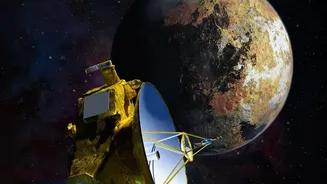
When the New Horizons probe flew past Pluto in 2015, scientists were expecting to see a surface battered and scarred by billions of years of impacts from space debris. An ancient, inactive world should be covered in craters. Instead, the first images
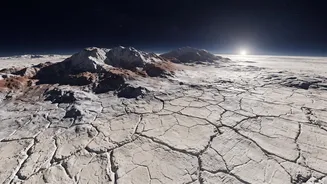
revealed vast, smooth plains, towering mountains of water ice, and a stunning lack of craters in certain areas. This was the first major clue that something was happening to actively reshape Pluto's surface. The most prominent of these young surfaces is Sputnik Planitia, the western lobe of Pluto's famous heart-shaped feature, which is a massive glacier of frozen nitrogen. Its smooth, cell-like patterns suggest the ice is churning in slow-motion convection, like a giant lava lamp, driven by a modest heat source from within.
Volcanoes Made of Ice
Perhaps the most dramatic evidence for Pluto's activity comes in the form of cryovolcanoes, or ice volcanoes. Instead of spewing molten rock, these volcanoes erupt a cold, slushy mixture of water, nitrogen, ammonia, or methane. Scientists identified two massive features, named Wright Mons and Piccard Mons, as potential cryovolcanoes. Wright Mons, for example, is about 150 kilometres wide and 4 kilometres high, comparable in volume to some of the largest volcanoes on Earth, like Hawaii's Mauna Loa. The area around these mountains is uniquely bumpy and shows very few impact craters, suggesting the terrain was formed by volcanic activity in the relatively recent geological past—perhaps within the last 100 million years.
The Engine Under the Ice
This all begs a huge question: where does the heat come from? Pluto is tiny and incredibly far from the Sun, so it should have lost most of its formation heat long ago. Unlike some of the icy moons of Jupiter and Saturn, it isn't being constantly squeezed and heated by the gravity of a nearby gas giant. The leading theory is that Pluto has managed to retain a surprising amount of internal heat from two sources: the slow decay of radioactive elements in its rocky core and residual heat from its formation. Scientists believe this warmth could be just enough to maintain a vast ocean of liquid water, possibly mixed with ammonia or other compounds that act as an antifreeze, deep beneath its icy shell.
More Than Just Volcanoes
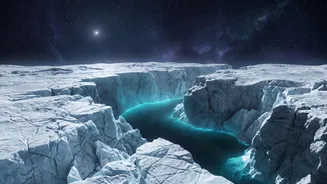
The evidence for an active interior doesn't stop with cryovolcanism. The very orientation of Sputnik Planitia suggests that the sheer weight of the ice in the basin caused the entire dwarf planet to roll over, putting immense stress on its crust. This process would have created huge cracks and faults in the surface, which New Horizons observed in the exact locations predicted by models. More recently, in 2026, scientists analyzing high-resolution images found evidence of massive landslides along the inner walls of several craters. These features indicate that the surface is still being actively modified, whether by tectonic stresses, impacts, or changes in surface ice. Even more recent analysis from August 2026 suggests liquid nitrogen may be welling up from below to temporarily wet the surface of the Sputnik Planitia glacier.
Redefining an 'Active' World
The discoveries on Pluto are forcing a major rethink of what it means for a world to be geologically active. It shows that even small, cold, and isolated bodies in the far reaches of the solar system can generate or retain enough heat to power complex geological processes. The potential existence of a subsurface ocean also dramatically expands the list of places in our solar system that could harbor liquid water, a key ingredient for life as we know it. While Pluto is unlikely to host life on its frigid surface, the possibility of a warm, watery environment deep inside is a tantalizing one. The data from New Horizons continues to be analyzed, promising that this distant dwarf planet has many more secrets to reveal.