




Finding the Dot in the Dark
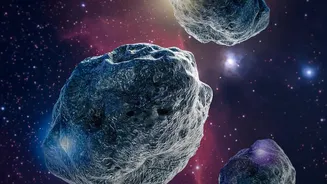
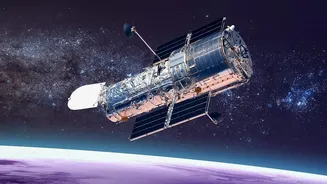
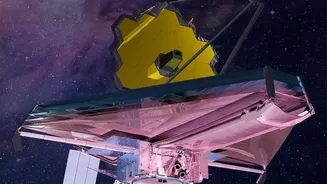
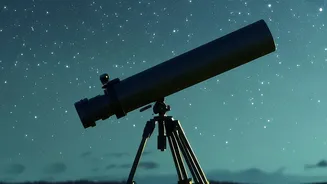
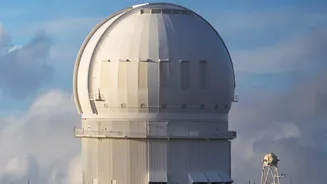
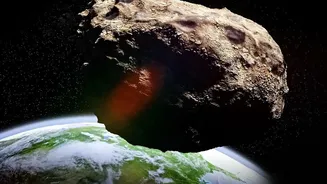
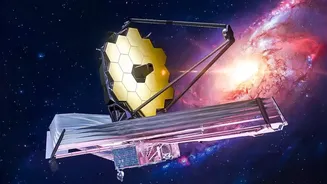
The first step is simply finding the asteroid. Astronomers use powerful optical telescopes to take a series of images of the same patch of sky, minutes or hours apart. Against the fixed backdrop of distant stars and galaxies, a near-Earth asteroid will
appear as a tiny point of light that has moved between exposures. This process of precisely measuring an object's position relative to background stars is called astrometry. By comparing these images, scientists can confirm they have found a moving object and begin the process of tracking it. These initial detections are often shared with a global network of observatories for follow-up observations to ensure the newly discovered object isn't lost.
Charting a Cosmic Trajectory
A few sightings are not enough to know an asteroid's destiny. To determine its direction and predict its future path, astronomers need to collect several observations over a period of days or even weeks. This series of data points, known as an observational 'arc', allows them to calculate a preliminary orbit. Using powerful computer models, they refine this orbit by accounting for the gravitational pull of the Sun and all the planets. This reveals the asteroid's trajectory—a precise path through space. This allows organizations like NASA and the European Space Agency to determine if the asteroid is a Potentially Hazardous Object (PHO), meaning its orbit brings it close to Earth.
Gauging Speed with Light's Color
Determining an asteroid's velocity is a two-part process. First, by tracking how fast the asteroid moves across the sky (its angular velocity), and knowing its distance, astronomers can calculate its tangential velocity—its speed perpendicular to our line of sight. The other component, its speed directly toward or away from us (radial velocity), is measured using spectroscopy. By splitting the asteroid's reflected sunlight into a spectrum, or rainbow, scientists look for shifts in the spectral lines. If the lines are shifted toward the blue end of the spectrum, the asteroid is moving toward us; a shift toward the red means it's moving away. The amount of this 'Doppler shift' reveals exactly how fast it's traveling in that dimension. Combining these two velocities gives a complete picture of its speed through space.
The Challenge of Weighing a Rock
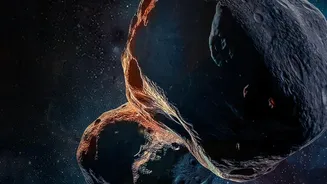
Directly measuring an asteroid's mass from millions of kilometers away is nearly impossible with an optical telescope alone. Instead, astronomers create an educated estimate by combining several clues. The first is size. An asteroid's brightness in visible light can be misleading because a small, reflective asteroid can look as bright as a large, dark one. By also observing it in infrared light, where brightness is more directly related to size, they can get a better estimate of its diameter. Next comes composition, determined through spectroscopy. Different minerals reflect light in unique ways, leaving signature 'fingerprints' in the spectrum. This tells scientists if the asteroid is a dense metallic body (M-type), a lighter stony one (S-type), or a porous carbonaceous one (C-type). By combining the estimated volume (from its size) with the likely density (from its composition), astronomers can arrive at a reasonable estimate of its mass. In rare cases where an asteroid has its own tiny moon, its mass can be calculated precisely by observing the moon's orbit.