

The Tyranny of the Rocket Equation
Any future crewed mission to Mars is governed by a ruthless mathematical reality. The sheer amount of mass required for the journey is staggering, and every kilogram launched from Earth costs thousands of dollars and immense amounts of fuel. The single
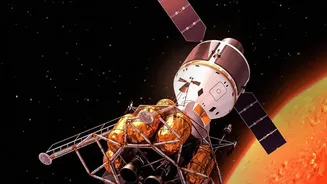
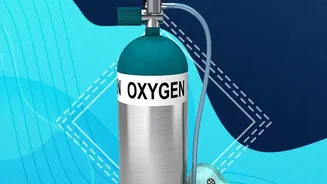
heaviest item for a return trip is not the astronauts, the food, or even the scientific equipment; it's the oxygen. Specifically, the liquid oxygen needed as a propellant oxidizer to launch a Mars Ascent Vehicle (MAV) off the Martian surface. To get a crew of four astronauts back into orbit would require an estimated 25 metric tons of oxygen. Launching an extra 25 tons from Earth just to bring it to Mars is a logistical nightmare that makes an already incredibly difficult mission borderline impossible. This single problem has been a major barrier to serious human exploration plans for decades.
Making Air From Thin Air
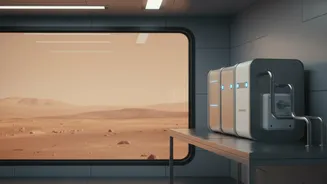
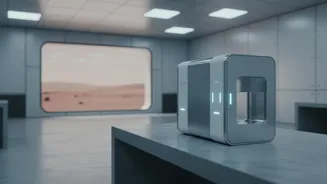
The solution is a concept called In-Situ Resource Utilization (ISRU), which is a straightforward idea: live off the land. Mars' atmosphere, while thin, is composed of 96% carbon dioxide (CO2). This is where electrolysis comes in. By using a device called a Solid Oxide Electrolysis cell, it's possible to do a bit of atmospheric alchemy. The process involves taking in the Martian air, heating it to around 800 degrees Celsius, and then passing an electrical current through it. This electrochemically splits the carbon dioxide molecules into their component parts: carbon monoxide, which is vented as a waste product, and pure, breathable oxygen. Instead of hauling tons of oxygen across the solar system, astronauts could literally make it out of the Martian air.
MOXIE: A Toaster-Sized Proof of Concept
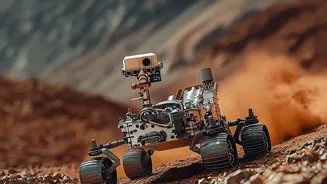
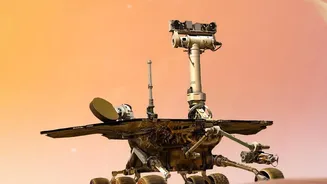
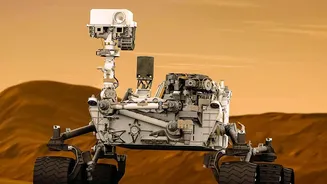
This isn't just a theory; it has already been done. Aboard NASA's Perseverance rover, which landed on Mars in 2021, is a small, toaster-sized instrument called the Mars Oxygen In-Situ Resource Utilization Experiment, or MOXIE. Over its mission, MOXIE successfully and repeatedly pulled in the Martian atmosphere and produced pure oxygen. It proved the fundamental principle works in the harsh, real-world conditions of Mars, operating in different seasons and times of day. While MOXIE's output was modest — generating about 10-12 grams of oxygen per hour, roughly equivalent to a small tree — its success was a monumental step. It demonstrated that ISRU is not science fiction, but a viable engineering pathway.
The Next Giant Leap: Scaling Up
The real challenge, and the focus of immense engineering effort, is scaling up. Going from MOXIE's grams-per-hour to the kilograms-per-hour needed for a full-scale oxygen plant is a massive undertaking. A system capable of producing the 25-30 tons of oxygen needed for a MAV would need to be about 100 to 200 times larger than MOXIE and run continuously for over a year before astronauts even arrive. This requires significant power, likely from a dedicated small nuclear reactor or extensive solar arrays sent to the planet. Companies like OxEon Energy are already working with NASA on next-generation systems, developing electrolysis stacks with significantly larger cell areas and improved stability designed to operate for thousands of hours. The goal is to land a fully automated, self-contained oxygen factory on Mars as a precursor mission, have it fill up a storage tank, and confirm the fuel for the ride home is ready and waiting before the first human boots ever touch the ground.
Beyond the Return Ticket
Solving the oxygen logistics problem does more than just enable a return journey. It fundamentally changes the economics and sustainability of a human presence on Mars. The same electrolysis process can be adapted. If water ice, which is known to exist on Mars, is mined and introduced, the same technology can produce not only oxygen but also hydrogen. Hydrogen can be combined with atmospheric carbon monoxide in a separate process to create methane—a rocket fuel. Suddenly, you have a system capable of producing both the oxygen (oxidizer) and the fuel for rockets, all sourced locally. This dramatically reduces the mass that needs to be shipped from Earth for every mission, paving the way for more permanent bases, more ambitious science, and a truly sustainable human foothold on another world.