








A Mission That Continues to Deliver
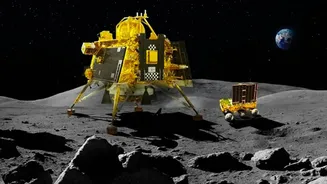
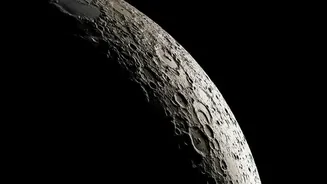
The successful soft landing of the Vikram lander near the Moon's south pole on August 23, 2023, was a moment of immense national pride for India and a landmark achievement in space exploration. But the mission's true legacy extends far beyond the landing itself.
The scientific instruments aboard the lander and the Pragyan rover have been collecting invaluable data, and recent findings are fundamentally changing our understanding of the very ground on which future astronauts may walk. A new analysis has provided the most detailed profile yet of the Moon's topmost soil, offering crucial insights for planning humanity's return to the lunar surface.
The Instrument Reading the Moon's Skin
The star of this new discovery is the Chandra’s Surface Thermophysical Experiment, or ChaSTE. This ingenious instrument was designed to do something that had never been done before: take the temperature of the lunar soil, or 'regolith', at different depths. ChaSTE uses a probe that can penetrate up to 10 centimetres beneath the surface, equipped with ten precise temperature sensors. By measuring how heat moves through the soil, scientists can deduce its physical properties—how dense, porous, or conductive it is. This is not just an academic exercise; these properties determine everything from how a landing craft will sit on the surface to how a habitat might be constructed.
A Three-Layer Surprise
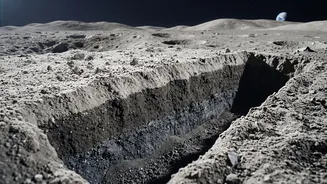
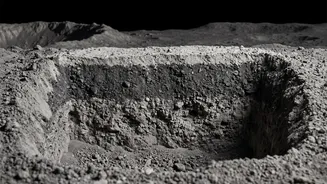
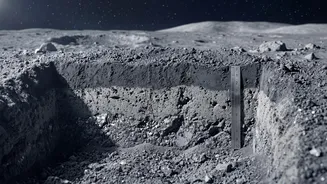
For years, scientists largely assumed the top layer of lunar regolith was relatively uniform. Chandrayaan-3 has proven this assumption wrong. A study based on ChaSTE data, published in 'npj Space Exploration', reveals a complex, three-layer structure within the top 10 centimetres. The very top layer, extending down about 3 cm, is extremely porous and fluffy—almost like a thermal blanket. Below that, from 3 to 6 cm, is a layer that conducts heat more effectively. Finally, from 6 to 10 cm, the soil becomes denser and more cohesive. This layered, 'cake-like' structure was an unexpected finding and shows that the lunar surface is far more complex than it appears.
Why the Top 10 Centimetres Are Crucial
This discovery is significant because almost all interaction with the Moon happens within this shallow layer. Landing gear, rover wheels, astronaut boots, and the foundations of any future habitat will all have to contend with these first few centimetres. The data from ChaSTE showed a wild temperature difference of about 73 Kelvin (a 73°C swing) across this 10 cm depth at local noon. The highly insulating top layer means the surface can get hot while the soil just centimetres below remains much cooler. This has massive implications. Understanding these thermal properties is essential for designing equipment that can survive the extreme temperature swings and for selecting sites where subsurface water ice might remain stable.
A New Blueprint for Lunar Exploration
With this detailed, in-situ data, space agencies around the world can now make much better-informed decisions. Selecting a landing site is a high-stakes process that involves balancing factors like sunlight for power, scientific interest, and, crucially, safety. The ChaSTE data provides a new, critical input for assessing the geotechnical and thermal stability of potential sites. A spot that looks perfectly flat from orbit might have a dangerously loose top layer, or its thermal properties might make it unsuitable for sensitive equipment. Thanks to Chandrayaan-3, future mission planners can now model the ground conditions with much higher accuracy, increasing the safety and success rate of missions that aim to establish a long-term human presence on the Moon.