



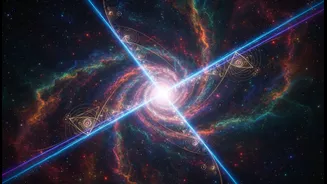



The Universe’s Lighthouses
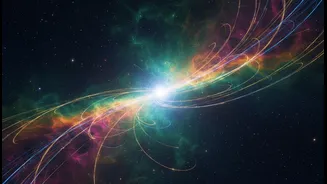
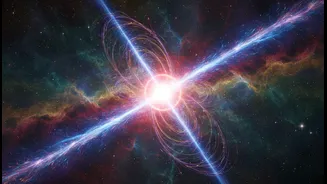
Imagine a star more massive than our sun, crushed into a space the size of a city. That’s a neutron star, one of the densest objects known to exist. Some of these are pulsars: rapidly spinning objects that emit powerful beams of radiation from their magnetic
poles. As the pulsar rotates, these beams sweep across space like a lighthouse. If Earth is in the path of one of these beams, our telescopes detect a regular pulse of energy. The pulsar at the heart of a recent NASA study, PSR J1101-6101, spins a dizzying 16 times every second.
An Invisible, Unmappable Force
For decades, one of the biggest mysteries surrounding pulsars has been their immense magnetic fields, which can be trillions of times stronger than Earth's. These fields are responsible for accelerating particles to nearly the speed of light, but they have been notoriously difficult to study directly. Scientists had theories and indirect measurements, but they couldn't create a definitive map of the magnetic structure that dictates how these extreme objects interact with their surroundings. Until now, these forces were powerful, but fundamentally invisible.
NASA’s New Set of Eyes
The breakthrough comes from NASA's Imaging X-ray Polarimetry Explorer, or IXPE. Launched in 2021, IXPE is a space telescope with a unique capability: it can measure the polarization of X-rays. Polarization is a property of light that reveals the orientation of its electric field. For astronomers studying pulsars, this is the key. By measuring the polarization of X-rays coming from the area around a pulsar, scientists can deduce the direction and structure of the magnetic field that produced them, essentially making the invisible visible. The mission is a collaboration between NASA and the Italian Space Agency.
What the First Map Revealed
In June 2025, IXPE stared at the so-called Lighthouse Nebula and its pulsar for nearly 18 days. The resulting data allowed scientists, for the first time, to directly map the magnetic field of the nebula powered by the pulsar. The study confirmed a long-held theory that high-energy particles escape the pulsar and travel along the galaxy's magnetic field lines, creating a long, thin filament. However, the map also delivered a surprise. The IXPE data showed that the magnetic field responsible for X-ray emissions ran parallel to the filament, but separate radio-wave observations showed a field oriented almost perpendicularly.
Why This Discovery Matters Now
This discovery is more than just confirming a theory; it opens up a new chapter in astrophysics. The conflicting orientations of the magnetic field at different wavelengths suggest that particles of different energies are being accelerated in very different ways within the same system. This challenges existing models and provides a natural laboratory for studying extreme physics that is impossible to replicate on Earth. By understanding how these cosmic particle accelerators work, we learn more about the life cycle of stars, the nature of ultra-dense matter, and the fundamental forces that shape our galaxy. This new ability to map magnetic fields provides a crucial new tool for understanding a wide range of cosmic objects, from black holes to other stellar remnants.