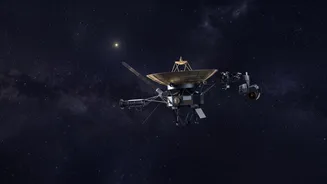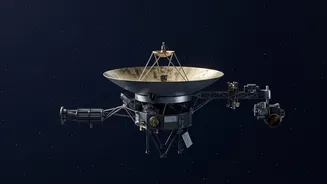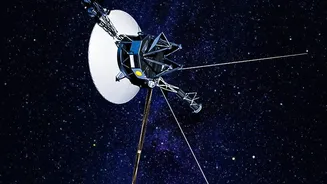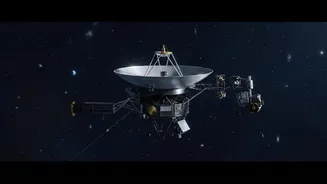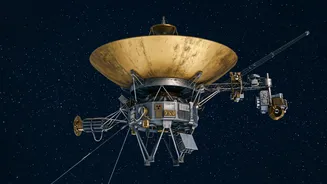

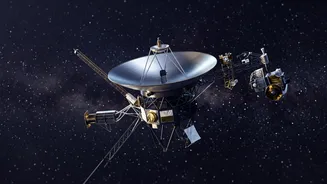
On November 18, 2026, a machine built by human hands will achieve something unprecedented. NASA’s Voyager 1 spacecraft, launched nearly 50 years ago, will be a full light-day away from Earth, a testament to endurance and discovery.
What is a Light-Day?
A light-day isn't a measure
of time, but of immense distance. It is how far a particle of light travels in a vacuum in 24 hours. That distance is approximately 25.9 billion kilometres, or about 16.1 billion miles. To put that into perspective, light from our Sun takes just over eight minutes to reach Earth. Neptune, our solar system's most distant planet, is about four light-hours away. On November 18, Voyager 1 will be so far away that a radio signal sent from Earth, travelling at the speed of light, will take a full 24 hours to reach it. Any response from the probe would take another 24 hours to return, meaning a simple round-trip communication will take two full days.
A Journey for the Ages
Launched on September 5, 1977, Voyager 1’s original mission was to explore the outer planets. Taking advantage of a rare planetary alignment, its primary goal was to conduct flybys of Jupiter and Saturn, studying their atmospheres, moons, and magnetic fields. The mission was a stunning success. Voyager 1 gave us our first detailed images of Jupiter’s swirling Great Red Spot and discovered volcanoes on its moon, Io. At Saturn, it revealed the breathtaking complexity of the planet's rings and found that the moon Titan was hidden by a thick nitrogen atmosphere. After its Saturn encounter in 1980, a gravitational assist sent Voyager 1 hurtling out of the plane of the planets and on a trajectory toward interstellar space. In August 2012, it became the first human-made object to cross the heliopause, the boundary where the Sun's influence gives way to the interstellar medium.
The Most Distant Human Object
For decades, Voyager 1 has been setting records. In February 1998, it officially became the most distant human-made object from Earth, surpassing the Pioneer 10 probe. It currently speeds through interstellar space at roughly 61,000 kilometres per hour. The light-day milestone on November 18 is significant because it highlights this incredible distance in a tangible way. While nothing physically marks this boundary in space, it represents a new chapter in communication lag, underscoring the challenges of operating a spacecraft in the cosmos. Its twin, Voyager 2, which took a longer route to visit Uranus and Neptune, is on track to reach its own light-day milestone in November 2035.
An Aging Explorer's Health
Keeping a nearly $50$-year-$old$ spacecraft operating is a monumental feat of engineering. Voyager $1$'s plutonium power source naturally decays, losing about four watts of power per year, forcing mission controllers to make difficult decisions about which instruments to shut down to conserve energy. The probe has also faced recent technical glitches. In late $2023$, it began sending back garbled data due to a faulty memory chip, a problem that engineers cleverly worked around over several months. More recently, in October $2026$, NASA briefly lost contact for $48$ hours before the signal was restored. Despite these challenges, the probe continues to send back valuable data from interstellar space, thanks to the tireless efforts of its team on Earth.
The Silent Journey Onward
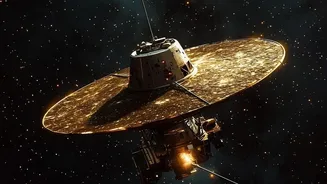
NASA expects to maintain contact with Voyager $1$ into the $2030$s,' though its scientific operations will become increasingly limited as power dwindles.' But even after it falls silent,' its journey will be far from over.' The spacecraft will continue to coast through the Milky Way for millions of years.' It carries with it the Golden Record,' a gold$-$plated copper disc containing sounds and images selected to portray the diversity of life and culture on Earth,' a time capsule for any civilization that might one day encounter it.' In about $40$,$000$ years,' Voyager $1$ will pass within $1.7$ light$-$years of a star named Gliese $445$. It’s a silent,' lonely voyage,' but one that carries the hopes and curiosity of all humanity.