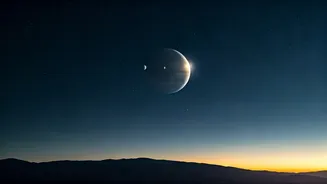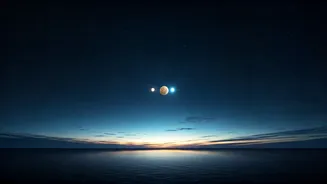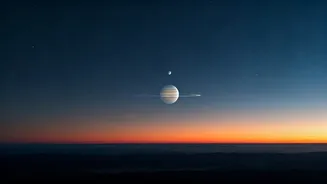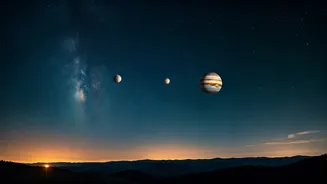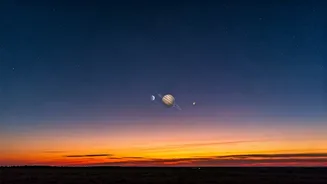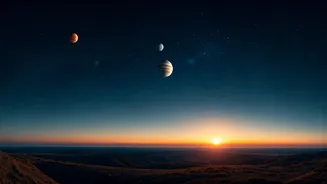



What Is This Planetary ‘Cluster’?
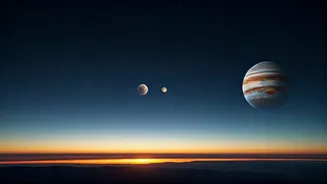
First, let's clear up what we're seeing. When we say 'cluster' or 'conjunction', it doesn't mean the planets are actually close to each other in space. Mercury, Venus, and Jupiter remain millions of kilometres apart, each orbiting the Sun on its own massive
path. What's happening is a beautiful illusion of perspective. From our vantage point here on Earth, their orbital paths are making them appear to line up in the same small patch of sky. Think of it like seeing two distant trees and a mountain peak all aligned in your view—they aren’t touching, but from where you stand, they create a single, striking image. This celestial line-of-sight effect is what creates these rare and often breathtaking planetary gatherings.
Meet the Stars of the Show
So, who are you looking for? The trio is unmissable, led by the two brightest 'stars' in our night sky that aren’t stars at all. **Venus:** You can’t miss it. Venus is the brightest object in the night sky after the Moon. Often called the 'Evening Star' or 'Morning Star', it shines with a brilliant, steady, silvery light. Its thick, toxic clouds are highly reflective, which is why it appears so dazzling to us. It will likely be the brightest point in the cluster. **Jupiter:** The king of the planets is the second brightest point of light in this trio. While not as intensely bright as Venus, Jupiter is still a magnificent sight, shining with a strong, unwavering glow. Even a basic pair of binoculars might reveal its four largest moons—Io, Europa, Ganymede, and Callisto—as tiny pinpricks of light huddled close to the planet. **Mercury:** This is the special guest. Mercury is the trickiest of the naked-eye planets to spot because it's the closest to the Sun. It never strays far from the Sun's glare, meaning we can only ever see it during a brief window at twilight or dawn. Tonight, its proximity to the super-bright Venus and Jupiter acts as a perfect signpost, making it much easier to locate this elusive little world.
When and Where to Look From India
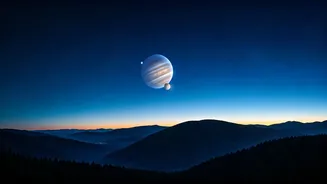
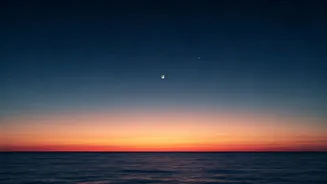
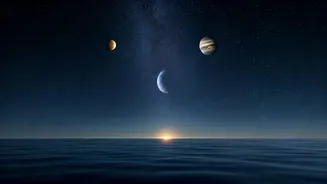
This is a post-sunset event. The best time to start looking is about 30 to 45 minutes after the Sun has completely disappeared below the horizon. This is the 'blue hour' of twilight when the sky is dark enough for the planets to shine but not so dark that they have set. You'll want to look low towards the western horizon—the same direction where the Sun just set. The planetary trio will appear as a tight triangle or a slightly slanted line of three bright 'stars'. Don't wait too long! Because they are so low on the horizon, they will follow the Sun and set themselves within about 60 to 90 minutes of sunset. The window of opportunity is short but incredibly rewarding.
Your Step-by-Step Viewing Guide
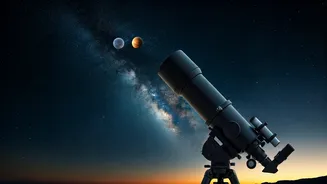
You don’t need any fancy equipment to enjoy this show—just your own eyes. Here’s how to get the best view: 1. **Find an Unobstructed View:** Your biggest challenge will be the horizon. Find a spot with a clear, low view to the west. This could be a rooftop, a park, the beach, or even an upper-floor window that faces the right direction. Buildings and trees can easily block the view, so elevation helps. 2. **Give Your Eyes Time:** Step outside about 15 minutes before you plan to start looking. This allows your eyes to adjust to the growing darkness, making it easier to pick out faint objects. 3. **Spot Venus First:** Scan the western sky for the brightest point of light. That's Venus. It will be unmistakable. Once you have it, you've found the anchor for the entire cluster. 4. **Find Jupiter and Mercury:** With Venus as your guide, look for the other two points of light nearby. Jupiter will be the second brightest. The faintest of the three will be Mercury. They will form a compact, noticeable pattern. 5. **Bring Binoculars (If You Have Them):** While not essential, a pair of binoculars will elevate the experience. They will make the colours of the planets more distinct and might even give you a glimpse of Jupiter's moons. Just be sure to wait until the Sun is completely gone before using them.