



A Pink World with Salty Skies
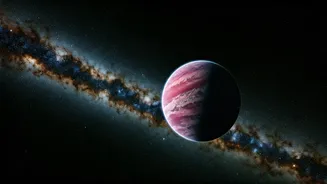
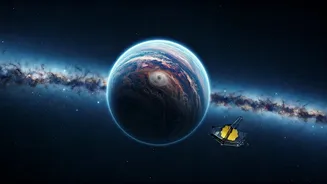
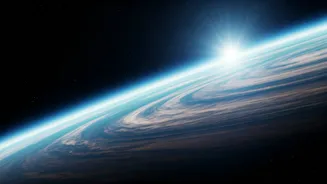
For over a decade, the celestial object known as GJ 504 b has been a source of intrigue. Located 57 light-years away, its distinct pinkish hue earned it the nickname the 'Pink Planet'. Due to its faintness, its true nature remained shrouded in mystery.
Now, thanks to the unparalleled power of the James Webb Space Telescope (JWST), astronomers have finally peered into its atmosphere. Recent findings published in June 2026 have confirmed the presence of water vapour, a crucial molecule in the search for habitable conditions. But the telescope found more than just water. The data revealed a complex atmospheric cocktail including methane, carbon dioxide, and ammonia. Most surprisingly, the analysis showed the planet's skies are filled with salty clouds, a phenomenon that had been theorized but never directly confirmed on such an object until now.
The Telescope That Pierced the Veil
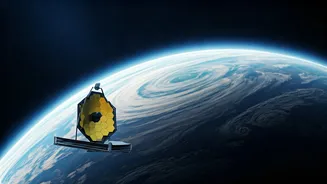
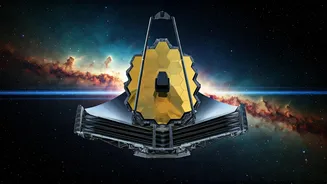
Unlocking the secrets of the Pink Planet was a challenge that ground-based telescopes could not overcome. The object is so dim and its host star so bright that its light was nearly impossible to analyze from Earth. This is where the James Webb Space Telescope changed the game. Orbiting far from Earth's atmospheric distortion, the JWST used its advanced instruments to capture the faint light of GJ 504 b. In just a couple of hours of observation time—a feat that would have been impossible previously—scientists were able to gather enough data to create a spectrum. This process involves breaking down the planet's light into its component colours, with different molecules leaving unique signatures. By analysing these signatures, the team could identify the specific chemical ingredients swirling in its atmosphere.
Why Finding Water Vapour Is a Big Deal
The detection of water vapour on any exoplanet is a landmark discovery for astronomers. While GJ 504 b itself is not considered habitable—it’s a gas giant with scorching temperatures—the presence of water is fundamentally important. Water is the universal solvent that facilitates the chemical reactions essential for life as we know it. Finding it in diverse planetary atmospheres helps scientists understand how prevalent this key ingredient is across the galaxy. Each detection provides a crucial data point, helping to refine models of how planets form and whether the building blocks of life are common or rare. It's a critical step toward the ultimate goal of identifying a rocky, temperate world with an atmosphere that could potentially support life.
A Planet or a Failed Star?
Adding to its mystique, astronomers are not entirely sure if GJ 504 b is a planet at all. With a mass roughly 25 times that of Jupiter, it sits on the fuzzy line that separates giant planets from brown dwarfs. Brown dwarfs are often called 'failed stars' because they are more massive than planets but lack the mass needed to ignite nuclear fusion in their cores and shine like true stars. For this reason, scientists often refer to GJ 504 b as a 'planetary-mass companion' rather than definitively a planet. This ambiguity makes the atmospheric findings even more valuable. Studying the chemical makeup of objects like this helps scientists better understand the full spectrum of celestial bodies that populate our galaxy, from the smallest planets to the largest stars.
A Glimpse into the Future
The discovery of salty clouds and water vapour on GJ 504 b does more than just solve the decade-old mystery of the Pink Planet. It provides the first direct, concrete evidence that salt clouds can exist in the atmosphere of a cold, planetary-mass object, confirming a long-held scientific theory. This breakthrough forces scientists to update their atmospheric models, reminding them to account for clouds when interpreting data from other worlds. It serves as a powerful demonstration of the JWST's ability to study faint, cold, and distant objects that were previously beyond our reach. The data from GJ 504 b is not just an answer to an old question, but a new guidepost for future explorations into the countless strange new worlds that await discovery.