





A Cosmic Shadow Play
It all starts with a technique called transit spectroscopy. Imagine watching a distant, bright light. If a planet passes directly in front of that light from our point of view—an event called a 'transit'—the light will dim slightly. The James Webb Space
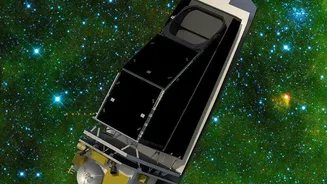
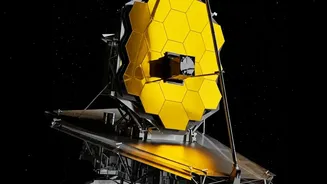
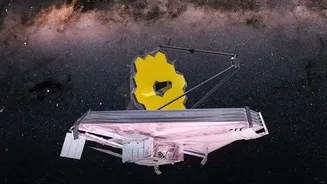
Telescope is sensitive enough to detect this minuscule dip in brightness. But it doesn't just measure the dimming; it analyzes the light that filters through the very edge of the planet, through its atmosphere. This is where the real magic begins. By observing the starlight before the transit and then again during it, scientists can isolate the light that has passed through the planet's atmosphere.
Webb’s Infrared Advantage
The key to Webb’s power is its ability to see the universe in infrared light. This is a range of light invisible to the human eye, but it’s perfect for studying exoplanets. Many of the most interesting molecules—like water, methane, and carbon dioxide—happen to absorb specific wavelengths of infrared light. Furthermore, infrared light can pierce through the clouds and haze that might otherwise obscure an atmosphere, giving scientists a clearer view of its chemical makeup. The telescope is equipped with a suite of incredibly sensitive instruments, primarily the Near-Infrared Spectrograph (NIRSpec) and the Mid-Infrared Instrument (MIRI), which work together to capture a broad spectrum of this light.
Reading a Barcode of Light
Once Webb's instruments capture the starlight that has passed through an exoplanet's atmosphere, they spread that light out into a spectrum, like a rainbow. This isn't just a pretty picture; it's a data-rich chart called a transmission spectrum. Different gases in the atmosphere absorb light at very specific wavelengths. This creates a unique pattern of dark lines or 'dips' in the spectrum—think of it as a chemical barcode. Water vapor will create a specific pattern of dips, methane another, and carbon dioxide yet another. By recognizing these unique absorption signatures, astronomers can confidently identify which gases are present in a world hundreds of light-years away.
From Data to Discovery
This process has already yielded spectacular results. On the hot gas giant WASP-96b, Webb found unambiguous evidence of water vapor. For another planet, WASP-39b, it provided a full menu of atmospheric ingredients, including the first-ever detection of sulfur dioxide in an exoplanet's atmosphere, a molecule created by chemical reactions powered by starlight. More recently, in May 2026, studies of the temperate, Saturn-sized planet TOI-199b revealed the presence of methane. And on the potential 'Hycean' (water ocean) world K2-18 b, Webb has detected methane and carbon dioxide, and even hints of dimethyl sulfide (DMS)—a substance on Earth produced almost exclusively by life. These aren't just lists of chemicals; they are clues to a planet's climate, weather, and formation history.