







A Personal Pressurised Bubble
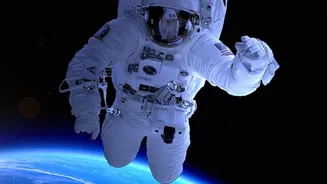
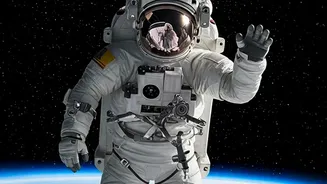
The most immediate threat in space is the vacuum. Without the atmospheric pressure we experience on Earth, a person would lose consciousness in seconds as oxygen leaves the blood and lungs. To counter this, a spacesuit is a wearable pressure vessel. The inner
layers include a rubber-like, airtight 'bladder' made of materials like urethane-coated nylon, which holds in breathable air. This is surrounded by a restraint layer, typically made of a strong fabric like Dacron, which prevents the bladder from ballooning outwards and gives the suit its human shape. This system maintains a pressure of about 4.3 pounds per square inch (psi) of pure oxygen, enough to keep an astronaut's body fluids stable and provide breathable air.
Surviving Extreme Temperatures
In Earth's orbit, an astronaut can experience scorching temperatures of 121°C in direct sunlight and freezing lows of -157°C in shadow. A spacesuit must act as a super-insulated thermos. This is achieved with multiple layers of aluminised Mylar, each separated by a spacer fabric, which reflects heat and limits temperature transfer. But insulation isn't enough. To manage the heat generated by an astronaut's own body, they wear a Liquid Cooling and Ventilation Garment underneath it all. This spandex-like undergarment has a network of tubes that circulate cool water, drawing heat away from the body. This water is then pumped to a unit in the backpack life support system, which uses a device called a sublimator to vent excess heat into space as ice crystals.
The Backpack: A Mobile Life Support System
The bulky backpack, known as the Primary Life Support System (PLSS), is the suit's command centre. It contains everything needed to sustain life for a spacewalk that can last up to eight hours. High-pressure tanks provide the pure oxygen the astronaut breathes. As they exhale, a fan circulates the air, and a filtration system removes the carbon dioxide to prevent a toxic buildup. The PLSS also houses the batteries that power the suit’s electronics, the pumps for the cooling system, and the two-way radio for communication with the spacecraft and mission control on the ground. Every function is critical; a failure in any one of these systems could be catastrophic.
A Shield Against Tiny Bullets
Space is not completely empty. It's filled with micrometeoroids and orbital debris, tiny particles travelling at speeds of up to 27,000 kilometres per hour. Even a fleck of paint can cause significant damage at these velocities. The outer part of a spacesuit, called the Thermal Micrometeoroid Garment, is designed to be a shield. It consists of multiple tough layers, including materials like Kevlar, the same fabric used in bulletproof vests. These layers are designed to break up and slow down incoming particles before they can puncture the inner pressure bladder, which would cause a fatal decompression. The white outer layer, often made of a blend including Gore-Tex and Nomex, also reflects solar radiation and resists tearing.
The Challenge of Dexterity
One of the greatest engineering challenges in spacesuit design is the gloves. Astronauts need to be able to perform delicate repairs and handle tools, but the pressurized nature of the suit makes the gloves stiff and difficult to bend. It’s often compared to working inside a pressurized balloon. Gloves are a multi-layered system in themselves, with a pressure bladder, a restraint layer, and an outer thermal and micrometeoroid layer. Designers have spent decades trying to improve flexibility without compromising protection. Astronauts often suffer from hand fatigue and even lose fingernails due to the sustained pressure and effort required to work in current glove designs. As such, improving glove dexterity and comfort is a major focus for next-generation suits like the AxEMU being developed for future Moon missions.