

The dream of setting foot on Mars is a powerful driver of modern science, but it raises a huge question: should we send robots or people? The answer is complex, involving immense risks, costs, and one truly fundamental hurdle: communication.
The Case for Robotic Explorers
Sending machines
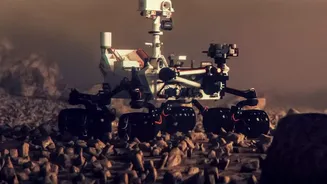
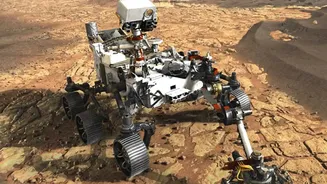
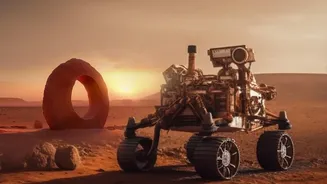
to Mars is, by far, the safer and more cost-effective option. Robotic missions eliminate the risk to human life, a paramount concern in the harsh environment of space. Robots are unfazed by lethal radiation, extreme temperatures, and the vacuum of space, allowing them to operate for years, sometimes decades, beyond their initial mission parameters. Rovers like NASA's Perseverance can carry sophisticated scientific instruments to analyse soil and atmosphere, making groundbreaking discoveries such as evidence of ancient water. These missions are also comparatively cheaper, as they don't require the massive and complex life-support systems, food, water, and return-trip capabilities essential for a human crew. For a fraction of the cost of a single human mission, space agencies can send multiple robotic explorers, gathering vast amounts of data that pave the way for future endeavours.
The Irreplaceable Human Element
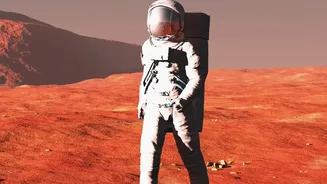
Despite the advantages of robots, many scientists argue that true exploration requires human intuition and adaptability. A human geologist can accomplish in a single week what a rover might take a year to do. Astronauts can make real-time decisions, improvise when faced with unexpected challenges, and apply a level of critical thinking that current AI cannot replicate. While a rover must follow meticulously planned instructions, a human can spot something interesting by chance, walk over, and investigate immediately—a flexibility that has led to major discoveries on past missions like Apollo. Furthermore, humans can perform complex physical tasks, like drilling deep into rock or repairing equipment, with a dexterity that far surpasses our current robotic capabilities. The search for something as subtle as fossilised microbial life may ultimately require a human on the ground, breaking open rocks and using their expertise to identify promising samples.
The Tyranny of Distance and Time
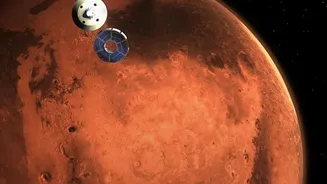
The single greatest obstacle for any Mars mission, robotic or human, is the immense communication delay. Because of the vast distance between Earth and Mars, which varies as the planets orbit the sun, a radio signal travelling at the speed of light can take anywhere from 3 to 22 minutes to travel one way. This means a simple question sent from Mission Control could take up to 44 minutes to receive a reply. This lag makes real-time control of a rover impossible; commands must be sent in carefully sequenced batches. For a human crew, this delay poses a profound challenge. In an emergency, astronauts cannot rely on immediate help from Earth. They must be trained and equipped to operate with unprecedented autonomy, making critical decisions about their survival on their own. Moreover, for about two weeks every 26 months, Mars and Earth are on opposite sides of the sun, causing a total communications blackout.
Bridging the Cosmic Communication Gap
Engineers are developing innovative solutions to mitigate these communication challenges. For robotic missions, the focus is on increasing autonomy through advanced AI, allowing rovers to navigate and make scientific decisions without constant human input. For human missions, the solution is twofold: rigorous psychological and technical training to ensure crew self-sufficiency, and developing new communication technologies. One of the most promising advancements is deep space laser communication. Systems like NASA's Deep Space Optical Communications (DSOC) have demonstrated the ability to transmit data at rates 10 to 100 times faster than current radio systems. This higher bandwidth could allow for high-definition video streaming and faster transmission of vital scientific data, though it does not solve the fundamental speed-of-light time delay.
India's Vision for the Red Planet
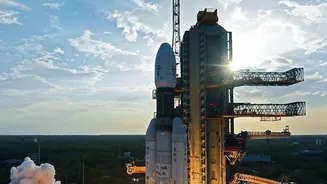
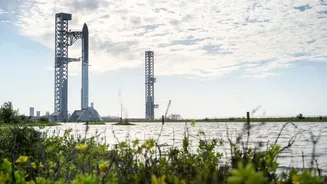
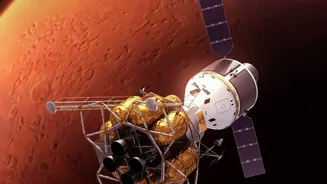
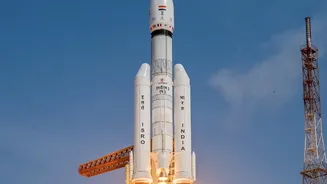
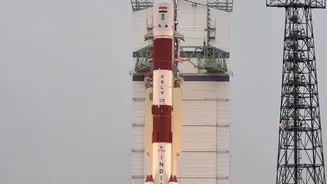
As a major spacefaring nation, India is also looking toward Mars with ambitious long-term goals. Following the historic success of its Mars Orbiter Mission (Mangalyaan), ISRO has developed a roadmap for the coming decades. While still in the planning stages, this vision includes precursor missions that could lead to landing humans on Mars. The roadmap also involves developing significantly more powerful launch vehicles and even exploring concepts like 3D-printed habitats on the Martian surface. This aligns with a global trend where human and robotic exploration are seen not as an 'either/or' choice, but as complementary parts of a single, sustained strategy. Robots serve as our scouts, mapping the terrain and identifying resources, making the path safer for the human explorers who will eventually follow.