


From Landing to Catching
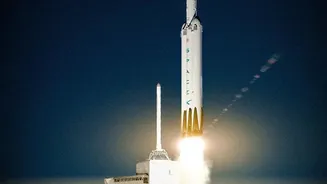
For years, the world has watched in awe as SpaceX’s Falcon 9 boosters descend from the edge of space to land perfectly on drone ships or concrete pads. That innovation slashed the cost of reaching orbit. With its next-generation Starship system, designed
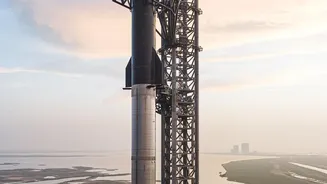
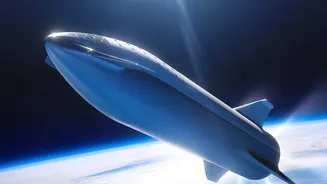
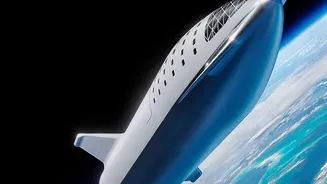
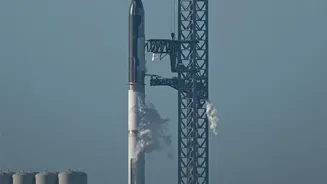
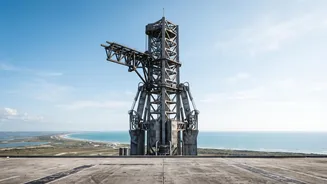
for missions to the Moon and Mars, SpaceX is taking reusability to a radical new level. Instead of landing legs, the massive Super Heavy booster is designed to be caught in mid-air by a set of enormous mechanical arms on the launch tower itself. This system, nicknamed 'Mechazilla' by the space community, is not just a dramatic flourish; it is the physical manifestation of SpaceX's entire economic model for the future of spaceflight.
Meet 'Mechazilla' and the 'Chopsticks'
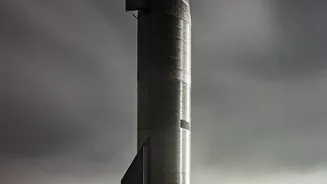
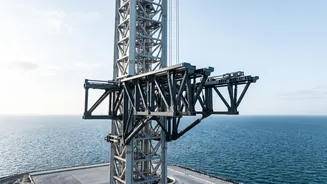
At the heart of this strategy is the launch and integration tower at SpaceX's Starbase facility in Texas. Standing over 400 feet tall, the structure is equipped with two massive, hydraulically actuated arms known as the 'chopsticks'. These arms serve a dual purpose. Before launch, they lift the Super Heavy booster onto the launch mount and then stack the Starship spacecraft on top of it. But their most critical role comes after stage separation. As the Super Heavy booster flies back to the launch site, performing a series of precise engine burns to slow its descent, the chopsticks position themselves to catch the vehicle just before it reaches the ground. The booster uses its grid fins—the large, waffle-like surfaces at its top—to steer itself with incredible precision toward the waiting arms.
Why Not Just Use Landing Legs?
The decision to eliminate landing legs from the Super Heavy booster is rooted in a core principle of rocketry: mass is the enemy. Every kilogram of structure a rocket has to carry is a kilogram of payload it can't. While the Falcon 9’s landing legs are an engineering marvel, they are dead weight for most of the mission. Removing them from the much larger Super Heavy saves a significant amount of mass, which directly translates to carrying more cargo, more fuel, or larger crews. Furthermore, this design distributes the landing loads across the booster's already-strong grid fin section, a part of the structure built to withstand immense aerodynamic forces, rather than requiring extra reinforcement at the base for legs. The hardware for landing is effectively moved from the rocket to the ground, where mass is not a penalty.
The Need for Speed
The even bigger driver behind the tower-catch strategy is speed. SpaceX's ultimate vision for Starship involves an 'airline-like' operational tempo, with the potential for multiple launches per day. This is essential for building a self-sustaining city on Mars, which would require launching enormous quantities of materials during limited interplanetary launch windows. A booster that lands on a remote drone ship or pad must be safed, inspected, and transported back to the launch site for refurbishment. By contrast, a booster caught by Mechazilla is already at the launch pad, perfectly positioned to be inspected, stacked with a new Starship, and refueled for its next flight within hours, not days or weeks. This rapid turnaround is the key enabler for making frequent, affordable flights to orbit and beyond a reality.
An Audacious Engineering Challenge
The maneuver is one of the most complex ever attempted in aerospace. It requires the autonomous coordination of multiple systems with centimeter-level precision. The tower uses LiDAR and high-resolution cameras to track the descending booster, while the booster itself makes constant adjustments. The entire catch sequence, from the final engine burn to the closing of the arms, is fully autonomous and happens in seconds. While SpaceX has successfully caught the Super Heavy booster on multiple test flights, the system is not without risk; on at least one occasion, an automated abort caused the booster to divert for a water landing instead. The next major milestone will be attempting to catch the Starship upper stage itself after it re-enters from orbit, a feat that has not yet been accomplished but is planned for upcoming flights.