






The Sun's Violent Outbursts
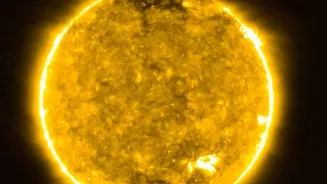
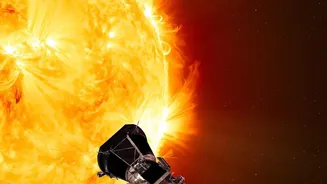
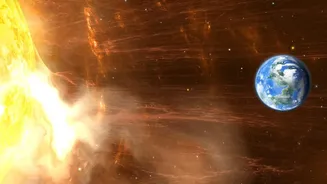
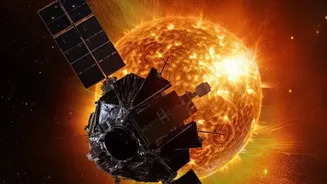
Space weather refers to the changing conditions in space, driven by the sun's activity. At the heart of this are solar flares—immense explosions on the sun's surface that release bursts of energy and radiation. When these explosions are particularly violent,
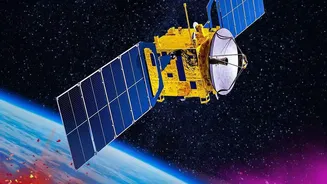
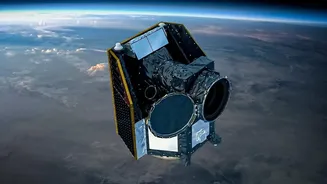
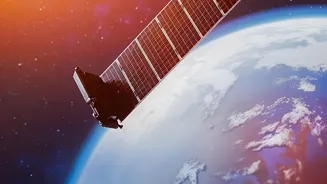
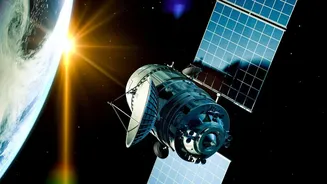
they can also cause a Coronal Mass Ejection (CME), which hurls billions of tonnes of magnetised plasma into space. While Earth's magnetic field protects us from most of this, a direct hit can have serious consequences for our technology-dependent society. These solar storms can disrupt radio signals, cause inaccuracies in GPS systems, and damage the sensitive electronics of satellites. In a worst-case scenario, a powerful event could knock out power grids or even lead to the premature re-entry of satellites from orbit, as seen in February 2022 when a solar storm destroyed dozens of newly launched Starlink satellites.
The Watchtowers on the Ground
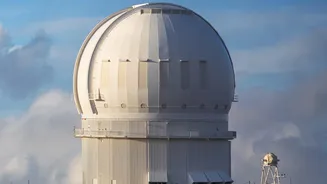
To protect against these threats, scientists rely on a global network of eyes on the sun: ground-based observatories. These facilities use specialised telescopes to continuously monitor solar activity. India plays a crucial role in this global effort. The Udaipur Solar Observatory (USO), strategically located on an island in Lake Fateh Sagar, is one of Asia's best sites for solar observation. The water body helps minimise atmospheric turbulence, allowing for clearer images of the sun's surface. Similarly, the Aryabhatta Research Institute of Observational Sciences (ARIES) in Nainital is another key player, specialising in solar physics and astrophysics. These observatories use instruments like H-alpha telescopes and magnetographs to track the development of sunspots and active regions, which are often precursors to solar flares.
India's Strategic Contribution
Indian observatories are geographically vital. ARIES, for example, is positioned in a longitude band between the Canary Islands and Eastern Australia, helping to fill a critical gap in 24/7 solar monitoring. Udaipur's observatory is part of the international Global Oscillation Network Group (GONG), a network of six observatories that provides continuous, round-the-clock data on the sun's activity. The data collected by facilities like the Multi-Application Solar Telescope (MAST) at USO helps scientists understand the complex magnetic fields that drive solar eruptions. This information is fed into national and international prediction models, like those run by the Center of Excellence in Space Sciences India (CESSI) at IISER Kolkata, which uses machine learning to forecast flare potential.
From Solar Data to Satellite Defense
So how does watching the sun translate into protection? It's a race against time. The intense light and X-rays from a solar flare reach Earth in about eight minutes, serving as the first warning. This can cause immediate radio blackouts on the sun-facing side of Earth. However, the more dangerous charged particles and CMEs travel much slower, taking anywhere from hours to several days to arrive. This gap is the crucial warning window. When observatories detect a significant event, they issue alerts through organisations like India's Regional Warning Centre (RWC-India) and NOAA's Space Weather Prediction Center. Satellite operators can then take preemptive action, such as putting their spacecraft into a protective 'safe mode', powering down sensitive components, or even adjusting their orbits to reduce atmospheric drag. Airlines may also reroute flights, particularly those over polar regions, to avoid communication disruptions and radiation exposure.